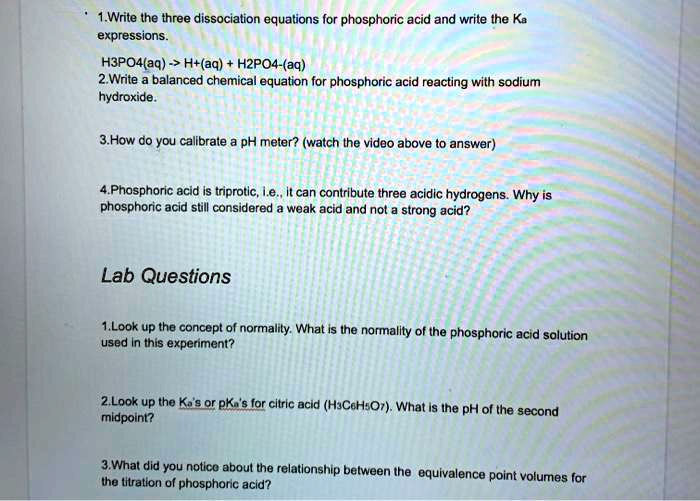
Write the three dissociation equations for phosphoric acid and write the Ka expressions: H3PO4(aq) > H+(aq) + H2PO4-(aq) H2PO4-(aq) > H+(aq) + HPO4^2-(aq) HPO4^2-(aq) > H+(aq) + PO4^3-(aq) Write balanced chemical equation for phosphoric acid reacting with sodium hydroxide. H3PO4(aq) + 3NaOH(aq) > Na3PO4(aq) + 3H2O(l) How do you calibrate pH meter? (watch the video above to answer) Phosphoric acid is triprotic; i.e. it can contribute three acidic hydrogens. Why is phosphoric acid still considered a weak acid and not a strong acid? Lab Questions: 1. Look up the concept of normality. What is the normality of the phosphoric acid solution used in this experiment? 2. Look up the Ka or pKa values for citric acid (H3C6H5O7). What is the pH of the second midpoint? 3. What did you notice about the relationship between the titration of phosphoric acid and the equivalence point volumes (or equivalence point volumes)
The Correct Answer and Explanation is:
Of course. Here are the correct answers to the questions provided, followed by a detailed explanation.
Correct Answers
1. Write the three dissociation equations for phosphoric acid and write the Ka expressions.
- 1st Dissociation: H₃PO₄(aq) ⇌ H⁺(aq) + H₂PO₄⁻(aq)
- Ka₁ = [H⁺][H₂PO₄⁻] / [H₃PO₄]
- 2nd Dissociation: H₂PO₄⁻(aq) ⇌ H⁺(aq) + HPO₄²⁻(aq)
- Ka₂ = [H⁺][HPO₄²⁻] / [H₂PO₄⁻]
- 3rd Dissociation: HPO₄²⁻(aq) ⇌ H⁺(aq) + PO₄³⁻(aq)
- Ka₃ = [H⁺][PO₄³⁻] / [HPO₄²⁻]
2. Write a balanced chemical equation for phosphoric acid reacting with sodium hydroxide.
The complete neutralization reaction is:
H₃PO₄(aq) + 3NaOH(aq) → Na₃PO₄(aq) + 3H₂O(l)
3. How do you calibrate a pH meter?
To calibrate a pH meter, you use at least two, and often three, standard buffer solutions with known, stable pH values (e.g., pH 4.01, 7.00, and 10.01). The process involves rinsing the electrode with deionized water, immersing it in the first buffer (typically pH 7), and adjusting the meter to read that exact pH. The electrode is then rinsed again and placed in the second buffer (e.g., pH 4), and the meter’s slope is adjusted. This two-point calibration ensures accuracy across a range of pH values.
4. Why is phosphoric acid still considered a weak acid and not a strong acid?
Phosphoric acid is considered a weak acid because it does not completely dissociate in water. The strength of an acid is determined by the extent of its first dissociation, not by how many protons it can donate. For phosphoric acid, the first acid dissociation constant (Ka₁) is approximately 7.5 x 10⁻³, which indicates that only a small fraction of H₃PO₄ molecules break apart to form H⁺ and H₂PO₄⁻ ions in solution. Strong acids, by contrast, have a Ka value much greater than 1, signifying nearly 100% dissociation.
Lab Questions
1. Look up the concept of normality. What is the normality of the phosphoric acid solution used in this experiment?
Normality (N) is a measure of concentration defined as the number of equivalents per liter of solution. For an acid, an equivalent is the amount of substance that donates one mole of protons (H⁺). Since phosphoric acid (H₃PO₄) can donate three protons, its normality is three times its molarity (N = 3 x M). The specific normality for the experiment depends on the molarity of the solution used, which is not provided in the question.
2. Look up the Ka’s or pKa’s for citric acid (H₃C₆H₅O₇). What is the pH of the second midpoint?
The approximate pKa values for citric acid are pKa₁ ≈ 3.13, pKa₂ ≈ 4.76, and pKa₃ ≈ 6.40. During a titration, the pH at the midpoint of a buffer region is equal to the pKa for that specific dissociation step. Therefore, the pH at the second midpoint of a citric acid titration is equal to its pKa₂, which is approximately 4.76.
3. What did you notice about the relationship between the equivalence point volumes for the titration of phosphoric acid?
The volume of titrant required to reach the second equivalence point is approximately double the volume required to reach the first equivalence point (V₂ ≈ 2 * V₁).
Detailed Explanation
Phosphoric acid (H₃PO₄) is an excellent example of a polyprotic weak acid, meaning it can donate more than one proton in a stepwise manner. Its classification as a weak acid stems from its first dissociation. The acid dissociation constant, Ka₁, is small (about 7.5 x 10⁻³), confirming that the equilibrium lies far to the left, with most of the acid remaining undissociated as H₃PO₄ molecules. Each subsequent proton is progressively harder to remove because it must be pulled away from an increasingly negative ion, which is reflected in the decreasing Ka values (Ka₂ ≈ 6.2 x 10⁻⁸; Ka₃ ≈ 4.2 x 10⁻¹³).
When titrating phosphoric acid with a strong base like sodium hydroxide (NaOH), this stepwise dissociation becomes visible on a titration curve. The reaction proceeds in stages, neutralizing one proton at a time. The first equivalence point is reached when all H₃PO₄ has been converted to H₂PO₄⁻. The second equivalence point occurs when all H₂PO₄⁻ has been converted to HPO₄²⁻. Because each step involves a one to one stoichiometric reaction between the available acidic proton and the hydroxide ion, the volume of base needed to proceed from the start to the first equivalence point is the same as the volume needed to go from the first to the second equivalence point. This results in a clear relationship where the total volume of base added to reach the second equivalence point is double the volume needed for the first.
Between these equivalence points are buffer regions known as midpoints. At a midpoint, the concentrations of the acid and its conjugate base are equal. According to the Henderson Hasselbalch equation, when this happens, the pH of the solution equals the pKa of the acid. For citric acid, another triprotic acid, the pH at its second midpoint would be equal to its pKa₂, which is around 4.76. Accurate measurement of these pH values requires a properly calibrated pH meter, which is standardized using buffers of known pH to ensure reliable readings