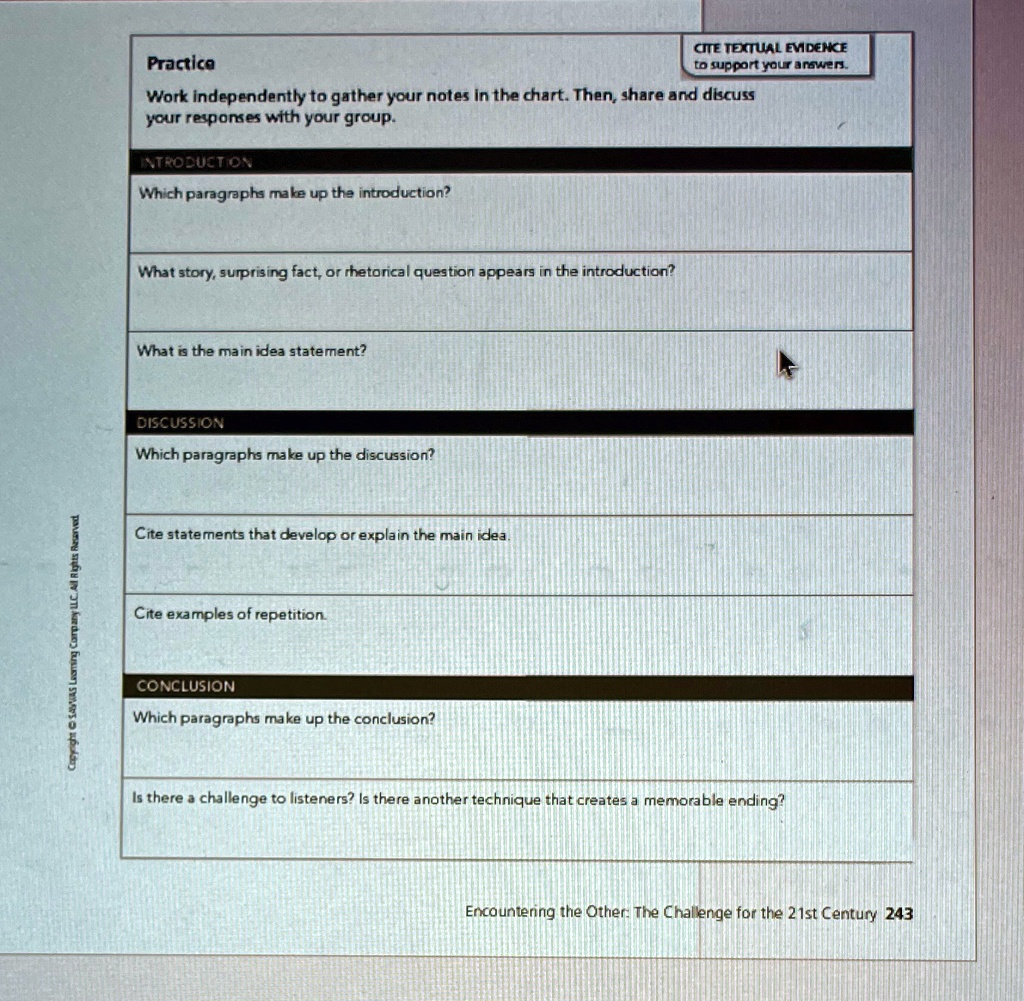
Encountering the Other: The Challenge for the 21st Century’ by Ryszard Kapuscinski USE TEXTUAL MINDMAP Practical Support Your Audience Work Independently to gather your notes in the chart. Then, share and discuss your responses with your group: Introduction Which paragraphs make up the introduction? What story, surprising fact, or rhetorical question appears in the introduction? What is the main idea statement? Discussion Which paragraphs make up the discussion? Cite statements that develop or explain the main idea. Cite examples of repetition. Conclusion Which paragraphs make up the conclusion? Is there a challenge to listeners? Is there another technique that creates a memorable ending? Encountering the Other: The Challenge for the 21st Century 243
The Correct Answer and Explanation is:
s “Encountering the Other: The Challenge for the 21st Century,” followed by a detailed explanation.
Worksheet Answers
INTRODUCTION
- Which paragraphs make up the introduction?
Paragraphs 1 and 2. - What story, surprising fact, or rhetorical question appears in the introduction?
Kapuściński begins with the story of the ancient Greek historian Herodotus, who was among the first to describe encounters with different peoples, establishing the concept of “the Other.” - What is the main idea statement?
The main idea is that for the first time in history, all of humanity is interconnected on a global scale, and our most significant challenge is to learn how to coexist peacefully through dialogue and understanding.
DISCUSSION
- Which paragraphs make up the discussion?
Paragraphs 3 through 10. - Cite statements that develop or explain the main idea.
Kapuściński explains three historical models for dealing with the Other: 1) engaging in war, 2) isolating oneself behind a wall, and 3) dominating and subjugating them. He then argues for a new, necessary approach: dialogue and a willingness to see the Other as an individual who reflects our own humanity. - Cite examples of repetition.
The phrase “the Other” is repeated consistently throughout the essay to emphasize the central concept. He also uses parallel sentence structures when describing the three historical attitudes, creating a strong rhetorical rhythm.
CONCLUSION
- Which paragraphs make up the conclusion?
Paragraphs 11 and 12. - Is there a challenge to listeners? Is there another technique that creates a memorable ending?
Yes, the challenge is for the audience to actively choose dialogue and empathy over historical patterns of conflict. TheHere are the correct answers for the worksheet based on Ryszard Kapuściński’s “Encountering the Other: The Challenge for the 21st Century.”
Practice Chart Answers
INTRODUCTION
- Which paragraphs make up the introduction?
Paragraphs 1 through 3 make up the introduction. - What story, surprising fact, or rhetorical question appears in the introduction?
Kapuściński begins with the historical story of the ancient Greeks, particularly the historian Herodotus, who helped shape European identity by defining it in opposition to “the Other,” a term for non-Greek peoples or barbarians. - What is the main idea statement?
The main idea is that the most significant challenge of the 21st century is determining how to coexist on a shared planet, presenting humanity with three fundamental choices: engage in conflict, build walls of isolation, or pursue dialogue.
DISCUSSION
- Which paragraphs make up the discussion?
Paragraphs 4 through 11 constitute the discussion section. - Cite statements that develop or explain the main idea.
- On the option of conflict: “The first of these consists in making war on the Other, in trying to annihilate him, to enslave him, to subordinate him, to humiliate him.”
- On the option of isolation: “The second possibility is to isolate oneself from the Other, to separate oneself from him with an impenetrable wall…”
- On the option of dialogue: “And so we come to the third possibility: dialogue, rapprochement, conversation, cooperation.”
- Cite examples of repetition.
The phrase “the Other” is repeated consistently throughout the essay to keep the central subject in focus. The idea of “our planet” as a “common home” is also used multiple times to emphasize global interconnectedness and shared responsibility.
CONCLUSION
- Which paragraphs make up the conclusion?
Paragraphs 12 through 14 form the conclusion. - Is there a challenge to listeners? Is there another technique that creates a memorable ending?
Yes, the text issues a direct challenge to the audience to choose the path of dialogue and mutual understanding. Kapuściński creates a memorable ending by memorable ending technique is his presentation of a choice between two futures: a “planet of war” or a “planet of great opportunity,” making the listener’s role in this choice feel urgent and profound.
Explanation
Ryszard Kapuściński’s essay “Encountering the Other” is structured to guide the reader from a historical problem to a modern solution. The worksheet prompts an analysis of this structure.
The introduction, spanning the first two paragraphs, sets the stage by using Herodotus as a historical anchor for the timeless act of meeting different cultures. This leads directly to Kapuściński’s main idea, which is that modern globalization presents a unique and urgent challenge, specifically the need for peaceful coexistence through mutual understanding.
The discussion section, the body of the work, elaborates on this challenge. Kapuściński develops his argument by first examining and dismissing three failed historical approaches to “the Other”: war, isolation, and domination. He strategically uses repetition, particularly of the phrase “the Other,” to keep the abstract concept at the forefront of the using inclusive language like “we” and “our” and by offering a hopeful vision of co-creating a “great universal metaculture,” which gives the reader a sense of purpose and shared destiny.
Explanation
Ryszard Kapuściński’s essay, “Encountering the Other,” is a structured argument about humanity’s future reader’s mind. By presenting these historical methods with parallel phrasing, he makes his critique clear and impactful. He then proposes his solution, a more enlightened path of dialogue, where we recognize our shared humanity in the people we meet.
Finally in a globalized world. The provided answers trace the clear, logical progression of his ideas from introduction to conclusion.
The introduction, the conclusion delivers a powerful call to action. Kapuściński directly challenges his audience to abandon old, destructive habits, spanning the first three paragraphs, establishes the historical and philosophical context. Kapuściński uses the story of Herodotus and the Greeks not merely as a historical fact but as a foundational narrative for how cultures have historically defined themselves against an external “Other.” He then pivots to the modern era, asserting that this encounter is no longer a choice but a daily reality for everyone. This leads to his central thesis statement, which presents the three distinct paths humanity can take: war, isolation, or dialogue and consciously participate in creating a more cooperative world. His closing technique is highly effective. He contrasts two potential destinies for humanity,.
The discussion, or body of the essay, systematically explores these three options in paragraphs 4 through 11. Kapuściński analyzes each path, dismissing conflict as destructive and isolation as impractical in an interconnected world. He methodically builds his case for the third option, dialogue, as the only viable and moral choice for survival and progress. His repeated use of the term “the Other” acts as a constant thematic anchor, while his references to “our planet” reinforce a planet of conflict or one of opportunity, which leaves the reader with a sense of responsibility and a memorable, thought provoking the idea of a shared fate.
Finally, the conclusion in paragraphs 12 through 14 serves as a powerful call final image. The entire essay builds toward this concluding choice, making it a compelling piece of rhetoric. to action. It moves beyond simply summarizing the argument. Kapuściński directly challenges the reader to embrace dialogue, not as a passive option but as an active, creative endeavor. His use of inclusive pronouns and the inspiring vision of a “universal metaculture” transforms the essay from a purely intellectual exercise into a memorable and moving appeal for a more tolerant and collaborative future, leaving a lasting impression on the audience