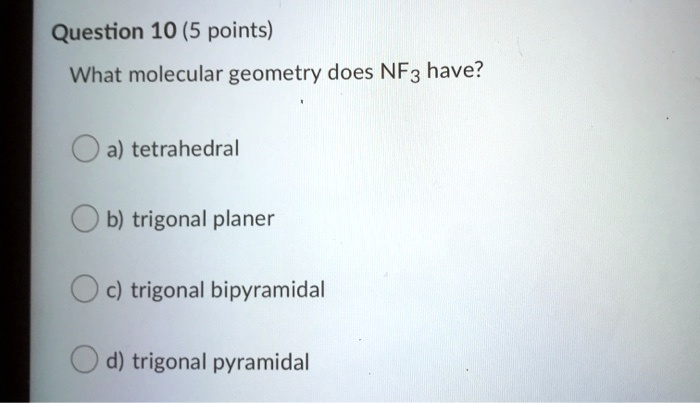
What molecular geometry does NF3 have? tetrahedral b) trigonal planer trigonal bipyramidal trigonal pyramidal
The Correct Answer and Explanation is:
The correct answer is d) trigonal pyramidal.
To determine the molecular geometry of Nitrogen Trifluoride (NF₃), we use the Valence Shell Electron Pair Repulsion (VSEPR) theory. This theory helps predict the shape of molecules by arranging electron pairs around the central atom in a way that minimizes electrostatic repulsion.
First, we identify the central atom, which is Nitrogen (N) as it is the least electronegative element (aside from hydrogen) and there is only one atom of it. Next, we determine the total number of valence electrons for the molecule. Nitrogen is in Group 15 of the periodic table, so it has 5 valence electrons. Fluorine is in Group 17, so each of the three Fluorine (F) atoms has 7 valence electrons. However, for the VSEPR model, we focus on the electron pairs around the central atom.
Nitrogen, with its 5 valence electrons, forms a single covalent bond with each of the three fluorine atoms. This uses 3 of nitrogen’s valence electrons for the bonding pairs. The remaining 5 – 3 = 2 valence electrons on the nitrogen atom exist as a single non-bonding lone pair.
Therefore, the central nitrogen atom is surrounded by a total of four electron domains: three bonding pairs (from the N-F bonds) and one lone pair. The arrangement of these four electron domains in space to be as far apart as possible is tetrahedral. This is known as the electron geometry.
However, the question asks for the molecular geometry, which describes the arrangement of only the atoms, not the lone pairs. With four electron domains and one of them being a lone pair (VSEPR formula AX₃E₁), the lone pair occupies one of the vertices of the tetrahedron. The remaining three vertices are occupied by the fluorine atoms. The resulting shape of the atoms is a pyramid with a triangular base, which is called trigonal pyramidal. The lone pair exerts a stronger repulsive force than the bonding pairs, pushing the N-F bonds closer together and reducing the F-N-F bond angle to approximately 102°, which is less than the ideal tetrahedral angle of 109.5°. This compression confirms the pyramidal structure