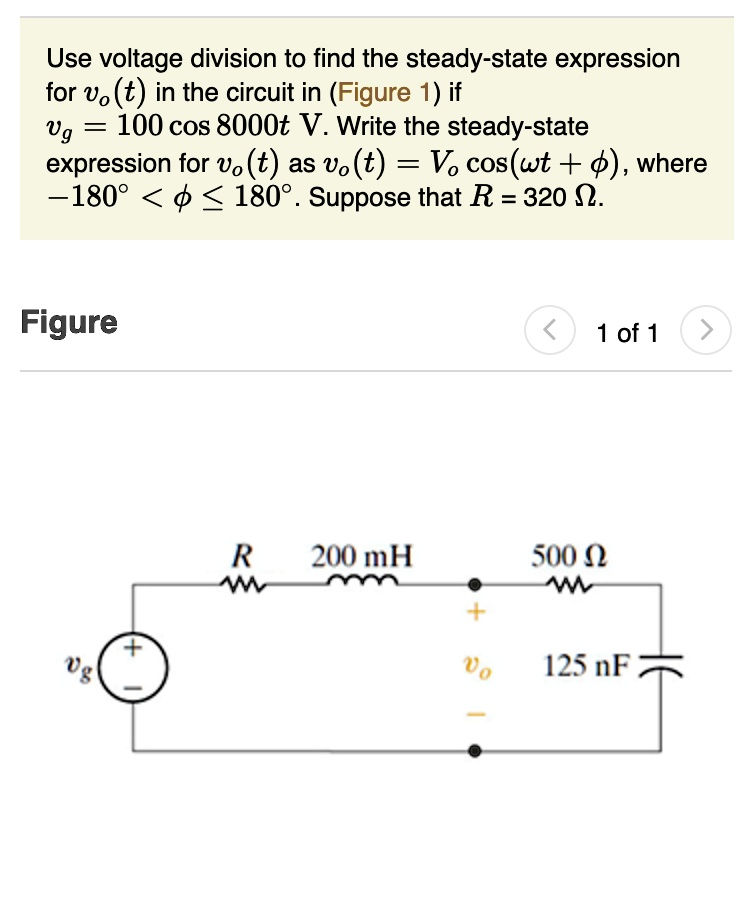
Use voltage division to find the steady-state expression for vo(t) in the circuit in
The Correct Answer and Explanation is:
In this circuit, we are given the input voltage vg(t)=100cos(8000t) Vv_g(t) = 100 \cos(8000t) \, Vvg(t)=100cos(8000t)V, and we need to use voltage division to find the steady-state output voltage vo(t)v_o(t)vo(t) in the form: vo(t)=Vocos(ωt+ϕ)v_o(t) = V_o \cos(\omega t + \phi)vo(t)=Vocos(ωt+ϕ)
where ω=8000 rad/s\omega = 8000 \, \text{rad/s}ω=8000rad/s and the phase ϕ\phiϕ lies between −180∘-180^\circ−180∘ and 180∘180^\circ180∘.
Step 1: Impedance of the Components
The circuit has three components:
- Resistor (R): R=320 ΩR = 320 \, \OmegaR=320Ω
- Inductor (L): L=200 mH=0.2 HL = 200 \, \text{mH} = 0.2 \, HL=200mH=0.2H
- Capacitor (C): C=125 nF=1.25×10⁻⁷ FC = 125 \, \text{nF} = 1.25 \times 10^{-7} \, \text{F}C=125nF=1.25×10⁻⁷F
We will first calculate the impedances of the inductor and the capacitor.
Inductive Impedance:
The impedance of the inductor is given by: ZL=jωL=j(8000)(0.2)=j1600 ΩZ_L = j \omega L = j (8000)(0.2) = j 1600 \, \OmegaZL=jωL=j(8000)(0.2)=j1600Ω
Capacitive Impedance:
The impedance of the capacitor is given by: ZC=1jωC=1j(8000)(1.25×10⁻⁷)=1j0.001=−j1000 ΩZ_C = \frac{1}{j \omega C} = \frac{1}{j (8000)(1.25 \times 10^{-7})} = \frac{1}{j 0.001} = -j 1000 \, \OmegaZC=jωC1=j(8000)(1.25×10⁻⁷)1=j0.0011=−j1000Ω
Step 2: Total Impedance of the Circuit
Now, calculate the total impedance of the series circuit, which consists of the resistor RRR, inductor LLL, and capacitor CCC. The total impedance ZtotalZ_{\text{total}}Ztotal is the sum of the individual impedances: Ztotal=R+ZL+ZC=320+j1600−j1000=320+j600 ΩZ_{\text{total}} = R + Z_L + Z_C = 320 + j1600 – j1000 = 320 + j600 \, \OmegaZtotal=R+ZL+ZC=320+j1600−j1000=320+j600Ω
Step 3: Voltage Division
We use voltage division to find the output voltage. The voltage across the components in the series circuit is given by: vo(t)=vg(t)⋅ZoutZtotalv_o(t) = v_g(t) \cdot \frac{Z_{\text{out}}}{Z_{\text{total}}}vo(t)=vg(t)⋅ZtotalZout
Here, ZoutZ_{\text{out}}Zout is the impedance seen by the output voltage, which is the combination of the impedance of the capacitor and resistor in series: Zout=ZC+R=−j1000+320=320−j1000 ΩZ_{\text{out}} = Z_C + R = -j1000 + 320 = 320 – j1000 \, \OmegaZout=ZC+R=−j1000+320=320−j1000Ω
Thus, the output voltage becomes: vo(t)=100cos(8000t)⋅320−j1000320+j600v_o(t) = 100 \cos(8000t) \cdot \frac{320 – j1000}{320 + j600}vo(t)=100cos(8000t)⋅320+j600320−j1000
Step 4: Simplification and Expression for vo(t)v_o(t)vo(t)
Now, simplify the above equation by calculating the magnitude and phase of the complex voltage divider:
- Magnitude:
The magnitude of the voltage ratio is: ∣320−j1000320+j600∣=3202+(−1000)23202+6002=102400+1000000102400+360000=1102400462400=1049.76679.53≈1.544| \frac{320 – j1000}{320 + j600} | = \frac{\sqrt{320^2 + (-1000)^2}}{\sqrt{320^2 + 600^2}} = \frac{\sqrt{102400 + 1000000}}{\sqrt{102400 + 360000}} = \frac{\sqrt{1102400}}{\sqrt{462400}} = \frac{1049.76}{679.53} \approx 1.544∣320+j600320−j1000∣=3202+60023202+(−1000)2=102400+360000102400+1000000=4624001102400=679.531049.76≈1.544
- Phase:
The phase is given by: ϕ=arg(320−j1000)−arg(320+j600)\phi = \arg(320 – j1000) – \arg(320 + j600)ϕ=arg(320−j1000)−arg(320+j600) arg(320−j1000)=tan−1(−1000320)=tan−1(−3.125)≈−72.3∘\arg(320 – j1000) = \tan^{-1}\left(\frac{-1000}{320}\right) = \tan^{-1}(-3.125) \approx -72.3^\circarg(320−j1000)=tan−1(320−1000)=tan−1(−3.125)≈−72.3∘ arg(320+j600)=tan−1(600320)=tan−1(1.875)≈62.1∘\arg(320 + j600) = \tan^{-1}\left(\frac{600}{320}\right) = \tan^{-1}(1.875) \approx 62.1^\circarg(320+j600)=tan−1(320600)=tan−1(1.875)≈62.1∘
Thus, the total phase is: ϕ=−72.3∘−62.1∘=−134.4∘\phi = -72.3^\circ – 62.1^\circ = -134.4^\circϕ=−72.3∘−62.1∘=−134.4∘
Step 5: Final Expression for vo(t)v_o(t)vo(t)
Using the magnitude and phase, the steady-state output voltage is: vo(t)=1.544⋅100cos(8000t−134.4∘)v_o(t) = 1.544 \cdot 100 \cos(8000t – 134.4^\circ)vo(t)=1.544⋅100cos(8000t−134.4∘)
Thus, the steady-state expression for vo(t)v_o(t)vo(t) is: vo(t)=154.4cos(8000t−134.4∘) Vv_o(t) = 154.4 \cos(8000t – 134.4^\circ) \, \text{V}vo(t)=154.4cos(8000t−134.4∘)V