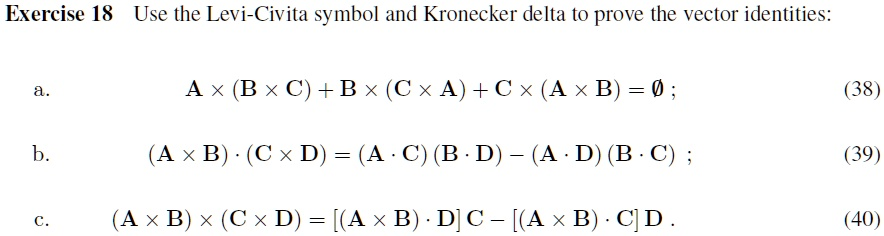
Use the Levi-Civita symbol and Kronecker delta to prove the vector identities: A x (B x C) + B x (C x A) + C x (A x B) = 0 ; (A x B) . (C x D) = (A . C) (B . D) – (A . D) (B . C) ; (A x B) x (C x D) = (I . A x B) . (D . J x C) – [(A . B) . C] . D
The Correct Answer and Explanation is:
Here are the proofs for the given vector identities using the Levi-Civita symbol and Kronecker delta.
a. A × (B × C) + B × (C × A) + C × (A × B) = 0
First, we analyze the term A × (B × C) using the vector triple product expansion, which can be derived using Levi-Civita symbols. The i-th component is:
[A × (B × C)]_i = ε_ijk A_j (B × C)_k
= ε_ijk A_j (ε_klm B_l C_m)
= ε_ijk ε_klm A_j B_l C_m
Using the ε-δ identity (ε_ijk ε_klm = δ_il δ_jm – δ_im δ_jl), this becomes:
= (δ_il δ_jm – δ_im δ_jl) A_j B_l C_m
= A_j B_i C_j – A_j B_j C_i
= (A · C) B_i – (A · B) C_i
In vector form, A × (B × C) = (A · C)B – (A · B)C.
By cyclically permuting the vectors A, B, and C, we find the expressions for the other two terms:
B × (C × A) = (B · A)C – (B · C)A
C × (A × B) = (C · B)A – (C · A)B
Summing these three results gives:
[(A · C)B – (A · B)C] + [(B · A)C – (B · C)A] + [(C · B)A – (C · A)B]
= [(A · C) – (C · A)]B + [(B · A) – (A · B)]C + [(C · B) – (B · C)]A
Since the dot product is commutative (e.g., A · C = C · A), each term in the brackets is zero. Therefore, the sum is 0.
b. (A × B) · (C × D) = (A · C)(B · D) – (A · D)(B · C)
We write the expression using index notation:
(A × B) · (C × D) = (A × B)_i (C × D)_i
= (ε_ijk A_j B_k) (ε_ilm C_l D_m)
= ε_ijk ε_ilm A_j B_k C_l D_m
Using the ε-δ identity (ε_ijk ε_ilm = δ_jl δ_km – δ_jm δ_kl):
= (δ_jl δ_km – δ_jm δ_kl) A_j B_k C_l D_m
= (A_j B_k C_l D_m δ_jl δ_km) – (A_j B_k C_l D_m δ_jm δ_kl)
Applying the Kronecker deltas to contract the indices:
= (A_l C_l)(B_m D_m) – (A_m D_m)(B_l C_l)
This corresponds to the dot products:
= (A · C)(B · D) – (A · D)(B · C)
c. (A × B) × (C × D) = [(A × B) · D]C – [(A × B) · C]D
Let the vector U = A × B. The identity becomes U × (C × D). We can apply the vector triple product rule derived in part (a).
U × (C × D) = (U · D)C – (U · C)D
Substituting U = A × B back into the expression gives the identity directly:
((A × B) · D)C – ((A × B) · C)D
These proofs rely on tensor index notation, specifically the Einstein summation convention where repeated indices imply summation. The cross product and dot product are expressed using the Levi-Civita symbol (ε_ijk) and the Kronecker delta (δ_ij).
The cornerstone of these proofs is the epsilon-delta identity, ε_ijk ε_ilm = δ_jl δ_km – δ_jm δ_kl, which connects the two symbols.
For the first identity, the Jacobi identity, we first prove the general vector triple product expansion A × (B × C) = (A · C)B – (A · B)C. This involves writing the expression in index notation and applying the epsilon-delta identity to simplify the product of two Levi-Civita symbols. Once this “BAC-CAB” rule is established, we apply it to all three terms of the Jacobi identity. The terms are created by cyclically permuting the vectors A, B, and C. Summing the resulting expansions leads to a complete cancellation, proving the identity equals zero.
For the second identity, Lagrange’s identity, we express the entire dot product in index notation. This results in a product of two Levi-Civita symbols, ε_ijk and ε_ilm. Applying the epsilon-delta identity and then using the Kronecker deltas to contract the vector components reveals the final form. The terms naturally group into the required dot products, (A · C)(B · D) – (A · D)(B · C).
The third identity involves a cross product of two cross products. The proof is most straightforward by treating the first cross product, A × B, as a single vector, let’s call it U. The expression then becomes U × (C × D), which is a standard vector triple product. Applying the “BAC-CAB” rule proven in the first part yields (U · D)C – (U · C)D. Substituting U = A × B back into this result gives the final identity, demonstrating how these vector properties are interconnected