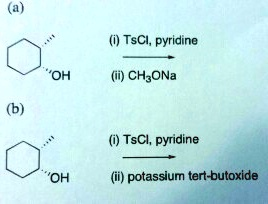
TsCl, pyridine OH (ii) CH3ONa (b) (i) TsCl, pyridine OH (ii) potassium tert-butoxide
TsCl, pyridine OH (ii) CH
ONa (b) (i) TsCl, pyridine OH (ii) potassium tert-butoxide
The Correct Answer and Explanation is:
Here are the products and the explanation for the given reactions.
Answer:
Both reaction (a) and reaction (b) produce the same major product: 3-methylcyclohexene.
Explanation:
Both reaction sequences begin with the same two steps, but the nature of the base used in the second step highlights a key principle in organic chemistry.
Step (i): Conversion to a Tosylate
The first step in both reactions (a) and (b) is the treatment of the starting alcohol, (1R,2R)-1-methylcyclohexan-2-ol, with p-toluenesulfonyl chloride (TsCl) in pyridine. This reaction converts the hydroxyl group (OH), a poor leaving group, into a tosylate group (OTs), which is an excellent leaving group. This transformation is crucial for the subsequent elimination reaction. The reaction occurs at the oxygen atom and does not change the stereochemistry at the carbon center, so the tosylate group remains in the same cis orientation relative to the methyl group.
Step (ii): E2 Elimination
The second step is an elimination reaction. For an E2 (bimolecular elimination) reaction to occur on a cyclohexane ring, the leaving group and a beta-proton (a proton on an adjacent carbon) must be in an anti-periplanar arrangement. This means they must both be in axial positions, pointing in opposite directions.
The intermediate, cis-1-methyl-2-tosyloxycyclohexane, exists in a chair conformation where the bulky methyl group preferentially occupies an equatorial position to minimize steric strain. This forces the adjacent tosylate group into an axial position.
With the tosylate group being axial, the E2 elimination requires an axial beta-proton. Let’s examine the two possible beta-carbons:
- Carbon 1: This carbon has a methyl group and no protons available for elimination.
- Carbon 3: This carbon has two protons. One is equatorial, and one is axial.
The E2 mechanism can only proceed by removing the axial proton on carbon 3, as it is the only one anti-periplanar to the axial tosylate leaving group. Therefore, the double bond must form between carbon 2 and carbon 3. This leads exclusively to the formation of 3-methylcyclohexene.
In reaction (a), sodium methoxide (CH3ONa) is a strong base that facilitates this E2 elimination. In reaction (b), potassium tert-butoxide is a strong, bulky base that also promotes the E2 reaction. Since substitution is sterically hindered and the stereoelectronic requirements for elimination are perfectly met, both reactions yield the same major product.