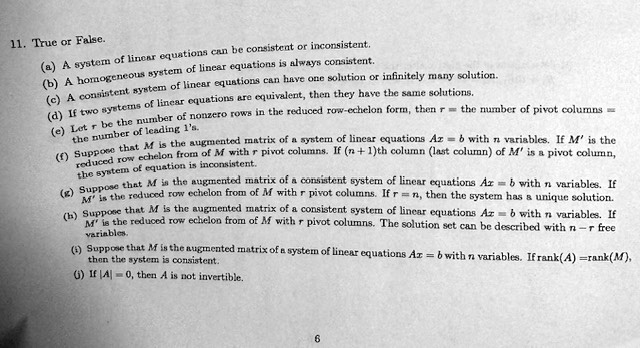
. True or False. (a) A system of linear equations can be consistent or inconsistent. (b) A homogeneous system of linear equations is always consistent. (c) A consistent system of linear equations can have one solution or infinitely many solution. (d) If two systems of linear equations are equivalent, then they have the same solutions. (e) Let
be the number of nonzero rows in the reduced row-echelon form, then
= the number of pivot columns = the number of leading 1’s. (f) Suppose that
is the augmented matrix of a system of linear equations
with
variables. If
is the reduced row echelon from of
with
pivot columns. If
th column (last column) of
is a pivot column, the system of equation is inconsistent. (g) Suppose that
is the augmented matrix of a consistent system of linear equations
with
variables. If
is the reduced row echelon from of
with
pivot columns. If
, then the system has a unique solution. (h) Suppose that
is the augmented matrix of a consistent system of linear equations
with
variables. If
is the reduced row echelon from of
with
pivot columns. The solution set can be described with
free variables. (i) Suppose that
is the augmented matrix of a system of linear equations
with
variables. If rank(A) = rank(M), then the system is consistent. (j) If
, then
is not invertible.
The Correct Answer and Explanation is:
Here are the correct answers for each statement, followed by a detailed explanation.
(a) True
(b) True
(c) True
(d) True
(e) True
(f) True
(g) True
(h) True
(i) True
(j) True
Explanation
All the provided statements are true, as they represent fundamental definitions and theorems in linear algebra.
Statement (a) is true by definition. A system of linear equations is classified as either consistent if it has at least one solution, or inconsistent if it has no solutions. These are the only two possibilities. Similarly, statement (d) is true by the definition of equivalent systems, which are two or more systems that possess the exact same solution set.
Statements (b) and (c) concern the nature of solutions. A homogeneous system of the form Ax = 0 is always consistent because the trivial solution (where all variables are zero, x = 0) is always a valid solution. This makes statement (b) true. For any consistent system, as described in statement (c), there are only two possible outcomes: a single, unique solution or an infinite number of solutions. A unique solution occurs when there are no free variables, while infinitely many solutions exist when there is at least one free variable.
Statements (e), (f), (g), and (h) relate to the properties of the reduced row-echelon form (RREF) of an augmented matrix. Statement (e) is true because, in RREF, each non-zero row contains exactly one leading 1, and each leading 1 defines a pivot column. Therefore, the number of non-zero rows, leading 1s, and pivot columns are all equal; this number is the rank of the matrix. Statement (f) provides the key test for inconsistency: a pivot in the last (augmented) column creates a contradictory row such as [0 … 0 | 1], which corresponds to the impossible equation 0 = 1.
Statements (g) and (h) describe consistent systems. If the number of pivots (r) equals the number of variables (n), as in (g), every variable is a leading variable, and the solution is unique. If r < n, then there are n – r free variables, as in (h), which can be parameterized to describe the infinite solution set.
Finally, statements (i) and (j) connect these ideas to rank and determinants. Statement (i), known as the Rouché–Capelli theorem, states that if the rank of the coefficient matrix A is equal to the rank of the augmented matrix M, it confirms no pivot exists in the augmented column, so the system is consistent. Statement (j) is a core property from the Invertible Matrix Theorem: a square matrix A is invertible if and only if its determinant is non-zero. Therefore, a zero determinant means the matrix is not invertible.