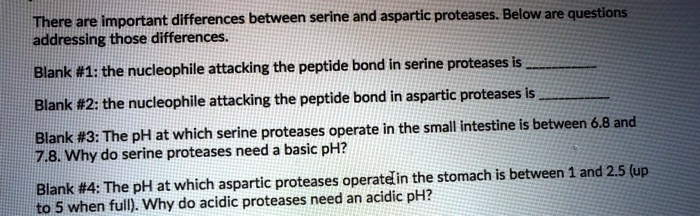
There are important differences between serine and aspartic proteases. Below are questions addressing those differences: Blank #1: The nucleophile attacking the peptide bond in serine proteases is . Blank #2: The nucleophile attacking the peptide bond in aspartic proteases is . Blank #3: The pH at which serine proteases operate in the small intestine is between 6.8 and 7.8. Why do serine proteases need a basic pH? Blank #4: The pH at which aspartic proteases operate in the stomach is between 1.5 and 2.5 (up to 4 when full). Why do acidic proteases need an acidic pH?
The Correct Answer and Explanation is:
Answer
Blank #1: the hydroxyl group of an active site serine residue
Blank #2: an activated water molecule
Blank #3: Serine proteases require a neutral to basic pH because their catalytic mechanism depends on a histidine residue in the active site being deprotonated (in its neutral, basic form) so it can act as a general base.
Blank #4: Aspartic proteases require a very acidic pH because their mechanism needs one active site aspartate residue to be protonated (to act as a general acid) while the other remains deprotonated (to act as a general base).
Explanation
The different pH optima for serine and aspartic proteases are a direct result of their distinct catalytic mechanisms and the specific amino acid residues involved.
For serine proteases, the key is the catalytic triad, which consists of a serine, a histidine, and an aspartate residue. The process begins with the histidine residue acting as a general base. For histidine to perform this role, it must be in its neutral, deprotonated state. The pKa of a histidine side chain is approximately 6.0. Therefore, in the slightly basic environment of the small intestine (pH 6.8 to 7.8), the histidine is deprotonated and can abstract a proton from the hydroxyl group of the nearby serine residue. This proton abstraction turns the serine’s hydroxyl group into a highly reactive and potent nucleophile, an alkoxide ion. This powerful nucleophile then attacks the carbonyl carbon of the target peptide bond, initiating its cleavage. If the pH were too acidic, the histidine would be protonated and unable to activate the serine, rendering the enzyme inactive.
In contrast, aspartic proteases, such as pepsin in the stomach, use a different strategy. Their active site contains a pair of aspartate residues. The nucleophile in this case is not part of the enzyme itself, but rather a water molecule. The mechanism requires one of the aspartate residues to act as a general base and the other to act as a general acid. The deprotonated aspartate (acting as a base) activates the water molecule by abstracting a proton, creating a hydroxide ion which is a strong nucleophile. Simultaneously, the protonated aspartate (acting as an acid) donates a proton to the carbonyl oxygen of the peptide bond. This makes the carbonyl carbon more electrophilic and thus more susceptible to attack by the activated water molecule. This dual requirement, needing one aspartate protonated and one deprotonated, is optimally met at a very low pH, like the acidic conditions of the stomach (pH 1 to 2.5). This environment ensures at least one of the aspartates is protonated and ready to act as a general acid to start the catalytic cycle.