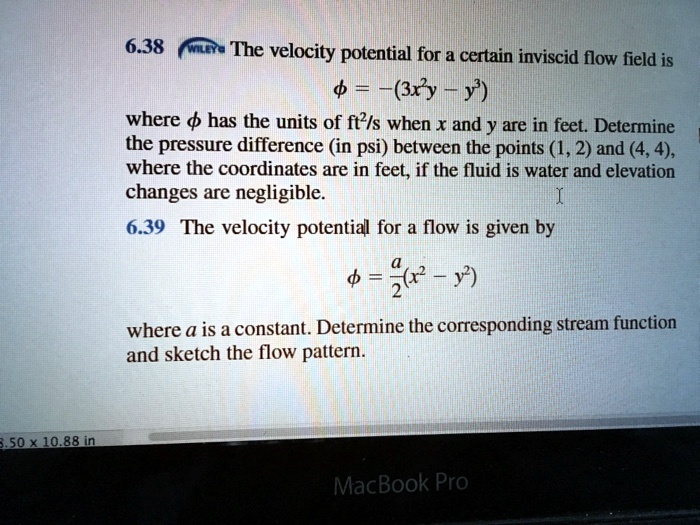
The velocity potential for a certain inviscid flow field is
where
has the units of ft
/s when x and y are in feet. Determine the pressure difference (in psi) between the points (1, 2) and (4, 4), where the coordinates are in feet, if the fluid is water and elevation changes are negligible. 6.39 The velocity potential for a flow is given by
where a is a constant. Determine the corresponding stream function and sketch the flow pattern.
The Correct Answer and Explanation is:
Let’s solve both problems:
Problem 6.38: Pressure difference in an inviscid water flow
Given the velocity potential:
ϕ=3x2y−y3\phi = 3x^2 y – y^3
From potential theory, velocity components are:
u=∂ϕ∂x=6xy;v=∂ϕ∂y=3×2−3y2u = \frac{\partial \phi}{\partial x} = 6xy \quad ; \quad v = \frac{\partial \phi}{\partial y} = 3x^2 – 3y^2
At point (1, 2):
u1=6(1)(2)=12 ft/s;v1=3(1)2−3(2)2=−9 ft/su_1 = 6(1)(2) = 12\ \text{ft/s} \quad ; \quad v_1 = 3(1)^2 – 3(2)^2 = -9\ \text{ft/s}
At point (4, 4):
u2=6(4)(4)=96 ft/s;v2=3(4)2−3(4)2=0 ft/su_2 = 6(4)(4) = 96\ \text{ft/s} \quad ; \quad v_2 = 3(4)^2 – 3(4)^2 = 0\ \text{ft/s}
Use Bernoulli’s equation for steady, incompressible, irrotational flow with negligible elevation changes:
ΔP=P1−P2=12ρ[(u22+v22)−(u12+v12)]\Delta P = P_1 – P_2 = \frac{1}{2} \rho \left[(u_2^2 + v_2^2) – (u_1^2 + v_1^2)\right]
Substitute values with ρ=62.4 lb/ft3\rho = 62.4\ \text{lb/ft}^3:
ΔP=12(62.4)[(96)2−(12)2+(−9)2]=31.2(9216−225)=31.2×8991=280,579.2 lb/ft2\Delta P = \frac{1}{2} (62.4) [(96)^2 – (12)^2 + (-9)^2] = 31.2 (9216 – 225) = 31.2 \times 8991 = 280,579.2\ \text{lb/ft}^2
Convert to psi:
ΔP=280,579.2144≈1948.47 psi\Delta P = \frac{280,579.2}{144} \approx \boxed{1948.47\ \text{psi}}
Problem 6.39: Stream function corresponding to given potential
Given:
ϕ=a2(x2−y2)\phi = \frac{a}{2}(x^2 – y^2)
Velocity components:
u=∂ϕ∂x=ax;v=∂ϕ∂y=−ayu = \frac{\partial \phi}{\partial x} = ax \quad ; \quad v = \frac{\partial \phi}{\partial y} = -ay
From potential-stream function relationships:
u=∂ψ∂y=ax⇒ψ=axy+f(x)u = \frac{\partial \psi}{\partial y} = ax \quad \Rightarrow \psi = axy + f(x)
v=−∂ψ∂x=−ay⇒∂ψ∂x=ayv = -\frac{\partial \psi}{\partial x} = -ay \quad \Rightarrow \frac{\partial \psi}{\partial x} = ay
From both equations, the stream function is:
ψ=axy\boxed{\psi = axy}
This represents a flow pattern of hyperbolas. Streamlines and equipotential lines are orthogonal and symmetric about the axes. The flow pattern is a classic example of an irrotational saddle flow with inflow along y and outflow along x when a>0a > 0.