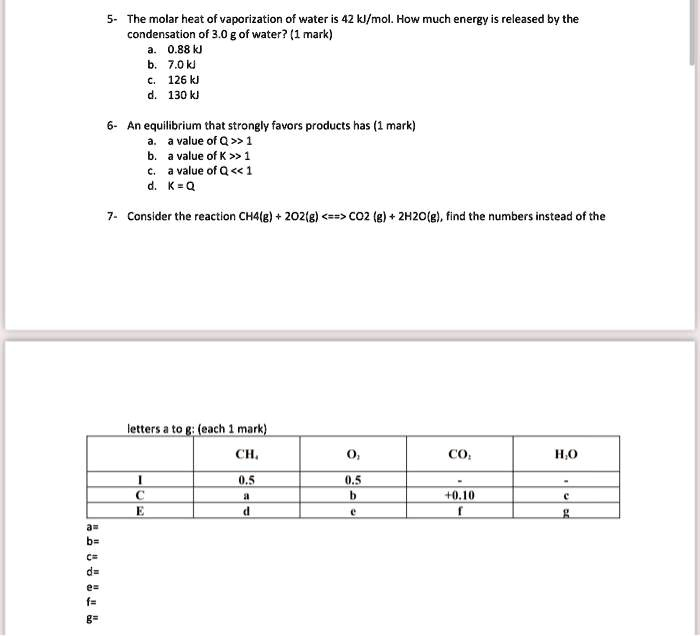
- The molar heat of vaporization of water is 42 kJ/mol. How much energy is released by the condensation of 3.0 g of water? (1 mark) a. 0.88 kJ b. 7.0 kJ c. 126 kJ d. 130 kJ 6- An equilibrium that strongly favors products has (1 mark) a. a value of Q >> 1 b. a value of K >> 1 c. a value of Q << 1 d. K = Q 7- Consider the reaction CH (g) + 2O (g) <=> CO
(g) + 2H
O(g), find the numbers instead of the letters a to g: (each 1 mark) CH
O
CO
H
O I 0.5 0.5 C a b +0.10 c E d e f g a= b= c= d= e= f= g
The Correct Answer and Explanation is:
Here are the correct answers for the questions presented in the image.
5. b. 7.0 kJ
6. b. a value of K >> 1
7.
a = -0.10
b = -0.20
c = +0.20
d = 0.40
e = 0.30
f = 0.10
g = 0.20
Explanation
Question 5: This question involves a thermochemical calculation. The molar heat of vaporization is the energy required to turn one mole of a liquid into a gas. Condensation is the opposite process (gas to liquid), so it releases the same amount of energy. The molar heat of condensation is therefore 42 kJ/mol. To find the total energy released for 3.0 g of water, we first need to convert the mass of water into moles. The molar mass of water (H₂O) is approximately 18.02 g/mol .
Moles of water = Mass / Molar Mass = 3.0 g / 18.02 g/mol ≈ 0.1665 mol.
Next, we multiply the number of moles by the molar heat of condensation to find the total energy released:
Energy released = Moles × Molar Heat of Condensation = 0.1665 mol × 42 kJ/mol ≈ 7.0 kJ. Thus, the correct answer is 7.0 kJ.
Question 6: This question tests the understanding of the equilibrium constant, K. The equilibrium constant is a ratio of the concentration of products to reactants at equilibrium. A large value for K (K >> 1) signifies that at equilibrium, the concentration of products is significantly greater than the concentration of reactants. This indicates that the forward reaction is highly favored, and the equilibrium “lies to the right,” strongly favoring the formation of products. In contrast, the reaction quotient, Q, describes the ratio at any given moment, not necessarily at equilibrium, and indicates the direction a reaction will shift to reach equilibrium.
Question 7: This problem requires completing an ICE (Initial, Change, Equilibrium) table for the reaction CH₄(g) + 2O₂(g) ⇌ CO₂(g) + 2H₂O(g). The changes in the amounts of reactants and products are dictated by the stoichiometric coefficients in the balanced equation. We are given that the change (C) for CO₂ is +0.10.
- Finding a, b, c (Changes): Based on the 1:2:1:2 molar ratio:
- a (CH₄): Reactant, ratio 1:1 with CO₂. Change = -(1/1) * 0.10 = -0.10.
- b (O₂): Reactant, ratio 2:1 with CO₂. Change = -(2/1) * 0.10 = -0.20.
- c (H₂O): Product, ratio 2:1 with CO₂. Change = +(2/1) * 0.10 = +0.20.
- Finding d, e, f, g (Equilibrium): The equilibrium amount (E) is the initial amount (I) plus the change (C).
- d (CH₄): E = 0.5 + (-0.10) = 0.40.
- e (O₂): E = 0.5 + (-0.20) = 0.30.
- f (CO₂): Assuming initial amount is 0, E = 0 + 0.10 = 0.10.
- g (H₂O): Assuming initial amount is 0, E = 0 + 0.20 = 0.20.