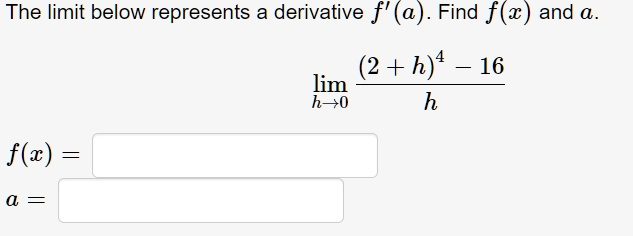
The limit below represents a derivative f’ (a). Find f(x) and a (2 + h)4 16 lim h-0 h f(e
The Correct Answer and Explanation is:
The given expression is:
limh→0(2+h)4−16h\lim_{{h \to 0}} \frac{{(2 + h)^4 – 16}}{h}
This matches the formal definition of the derivative of a function f(x)f(x) at a point aa:
f′(a)=limh→0f(a+h)−f(a)hf'(a) = \lim_{{h \to 0}} \frac{{f(a + h) – f(a)}}{h}
To identify f(x)f(x) and aa, observe the structure of the numerator:
(2+h)4−16(2 + h)^4 – 16
The expression (2+h)4(2 + h)^4 corresponds to f(a+h)f(a + h), and the constant term 16 represents f(a)f(a). Therefore, we deduce that the function evaluated at aa yields:
f(a)=16f(a) = 16
Looking at (2+h)4(2 + h)^4, it appears to be the function f(x)=x4f(x) = x^4, shifted to center at x=2x = 2. If we assume f(x)=x4f(x) = x^4, then:
f(2)=24=16f(2) = 2^4 = 16
This confirms our assumption. So, the function is f(x)=x4f(x) = x^4 and the point aa is 2.
Final Answer:
f(x)=x4,a=2f(x) = x^4, \quad a = 2
Explanation:
This problem exemplifies the definition of a derivative at a point. The general form measures the instantaneous rate of change of the function at a certain input. By comparing the structure of the given limit to the standard derivative form, we identify both the function rule and the specific input.
In our case, f(a+h)=(2+h)4f(a + h) = (2 + h)^4 implies f(x)=x4f(x) = x^4, and since f(2)=16f(2) = 16, it verifies that a=2a = 2. The numerator represents the change in the function’s output as the input varies slightly from 2 to 2+h2 + h, and dividing by hh yields the average rate of change, which becomes the derivative as hh approaches zero.
This limit thus represents the derivative of f(x)=x4f(x) = x^4 evaluated at x=2x = 2, which is f′(2)=4×3=32f'(2) = 4x^3 = 32, though the question only asks for f(x)f(x) and aa.