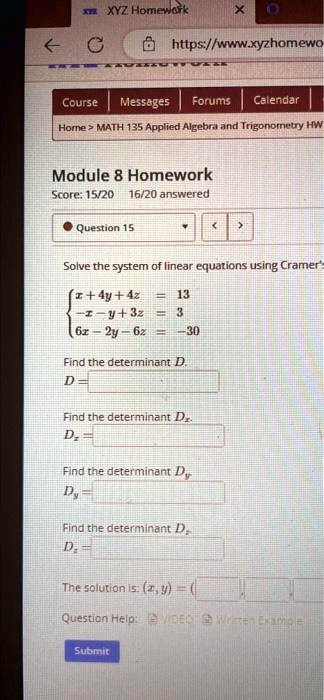
Solve the system of linear equations using Cramer's
The Correct Answer and Explanation is:
Here are the solutions to the problem:
D = 92
Dx = -276
Dy = 276
Dz = 92
The solution is: (x, y, z) = (-3, 3, 1)
Explanation
This problem requires solving a system of three linear equations using Cramer’s rule. The given system is:
x + 4y + 4z = 13
-x – y + 3z = 3
6x – 2y – 6z = -30
First, we must find the determinant of the coefficient matrix, denoted as D. The coefficient matrix is formed using the coefficients of the x, y, and z variables.
The coefficient matrix (A) is:
| 1 4 4 |
| -1 -1 3 |
| 6 -2 -6 |
The determinant D is calculated by expanding along the first row:
D = 1 * ((-1)(-6) – (3)(-2)) – 4 * ((-1)(-6) – (3)(6)) + 4 * ((-1)(-2) – (-1)(6))
D = 1 * (6 + 6) – 4 * (6 – 18) + 4 * (2 + 6)
D = 1 * (12) – 4 * (-12) + 4 * (8)
D = 12 + 48 + 32 = 92.
Next, we find the determinant Dx. We form a new matrix by replacing the first column (x coefficients) of the coefficient matrix with the constant terms from the equations (13, 3, -30).
The matrix for Dx is:
| 13 4 4 |
| 3 -1 3 |
| -30 -2 -6 |
Dx = 13 * ((-1)(-6) – (3)(-2)) – 4 * ((3)(-6) – (3)(-30)) + 4 * ((3)(-2) – (-1)(-30))
Dx = 13 * (12) – 4 * (72) + 4 * (-36)
Dx = 156 – 288 – 144 = -276.
Then, we find the determinant Dy by replacing the second column (y coefficients) with the constant terms.
The matrix for Dy is:
| 1 13 4 |
| -1 3 3 |
| 6 -30 -6 |
Dy = 1 * ((3)(-6) – (3)(-30)) – 13 * ((-1)(-6) – (3)(6)) + 4 * ((-1)(-30) – (3)(6))
Dy = 1 * (72) – 13 * (-12) + 4 * (12)
Dy = 72 + 156 + 48 = 276.
After that, we find the determinant Dz by replacing the third column (z coefficients) with the constant terms.
The matrix for Dz is:
| 1 4 13 |
| -1 -1 3 |
| 6 -2 -30 |
Dz = 1 * ((-1)(-30) – (3)(-2)) – 4 * ((-1)(-30) – (3)(6)) + 13 * ((-1)(-2) – (-1)(6))
Dz = 1 * (36) – 4 * (12) + 13 * (8)
Dz = 36 – 48 + 104 = 92.
Finally, we use Cramer’s rule to find the values of x, y, and z.
x = Dx / D = -276 / 92 = -3
y = Dy / D = 276 / 92 = 3
z = Dz / D = 92 / 92 = 1
Therefore, the unique solution to the system of equations is (x, y, z) = (-3, 3, 1).