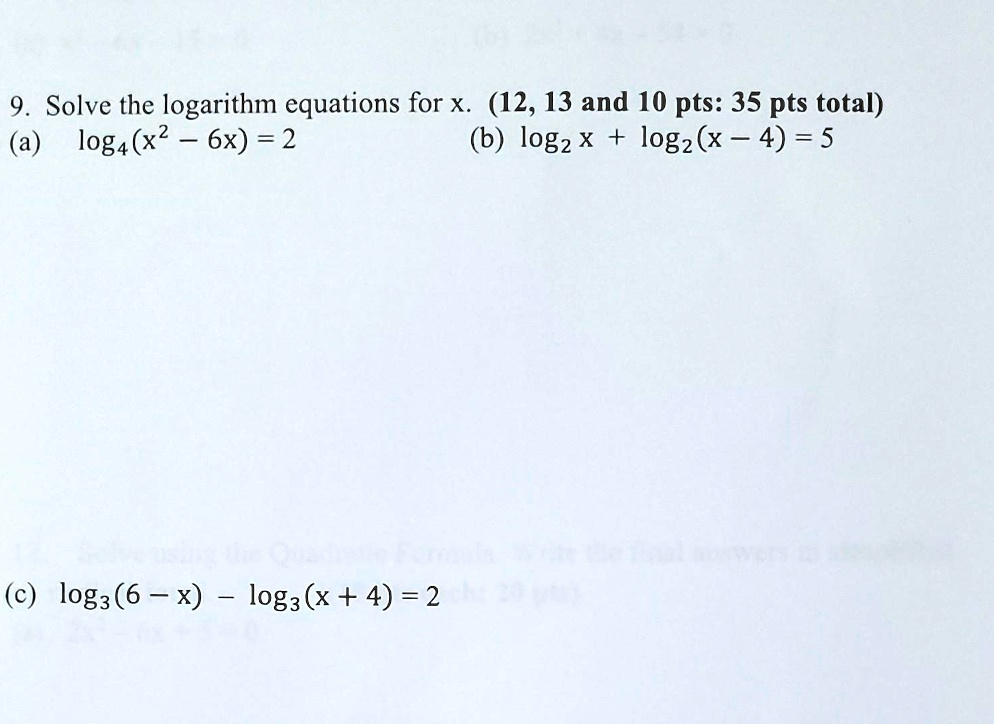
Solve the logarithm equations for x.
The Correct Answer and Explanation is:
Here are the solutions to the logarithm equations.
a) log₄(x² – 6x) = 2
To solve this equation, we first convert it from logarithmic form to its equivalent exponential form. The relationship is logₐ(b) = c is the same as aᶜ = b. Applying this to the given equation, the base is 4, the exponent is 2, and the argument is x² – 6x.
This gives us:
4² = x² – 6x
16 = x² – 6x
Now, we rearrange the equation into a standard quadratic form (ax² + bx + c = 0) by subtracting 16 from both sides:
x² – 6x – 16 = 0
We can solve this quadratic equation by factoring. We look for two numbers that multiply to -16 and add to -6. These numbers are -8 and 2.
(x – 8)(x + 2) = 0
This yields two possible solutions: x = 8 and x = -2.
Finally, we must check both solutions in the original equation because the argument of a logarithm must be positive.
For x = 8: x² – 6x = (8)² – 6(8) = 64 – 48 = 16. Since 16 > 0, this solution is valid.
For x = -2: x² – 6x = (-2)² – 6(-2) = 4 + 12 = 16. Since 16 > 0, this solution is also valid.
The solutions for (a) are x = 8 and x = -2.
b) log₂(x) + log₂(x – 4) = 5
This equation involves the sum of two logarithms with the same base. We use the product rule for logarithms, which states logₐ(M) + logₐ(N) = logₐ(MN), to combine the terms on the left side.
log₂(x(x – 4)) = 5
log₂(x² – 4x) = 5
Next, we convert this logarithmic equation to its exponential form:
2⁵ = x² – 4x
32 = x² – 4x
Rearrange into a standard quadratic equation:
x² – 4x – 32 = 0
Factor the quadratic equation. We need two numbers that multiply to -32 and add to -4. These are -8 and 4.
(x – 8)(x + 4) = 0
The possible solutions are x = 8 and x = -4. We must check these against the original equation’s domain. The arguments of both logarithms, x and (x – 4), must be positive.
For x = 8: x = 8 (which is > 0) and x – 4 = 8 – 4 = 4 (which is > 0). This solution is valid.
For x = -4: x = -4 (which is not > 0). This is an extraneous solution and must be discarded.
The solution for (b) is x = 8.
c) log₃(6 – x) – log₃(x + 4) = 2
We start by applying the quotient rule for logarithms, logₐ(M) – logₐ(N) = logₐ(M/N), to combine the terms.
log₃((6 – x) / (x + 4)) = 2
Convert to exponential form:
3² = (6 – x) / (x + 4)
9 = (6 – x) / (x + 4)
Now, solve for x. Multiply both sides by (x + 4):
9(x + 4) = 6 – x
9x + 36 = 6 – x
Isolate the x term:
10x = -30
x = -3
Finally, check if the solution is valid by ensuring the original arguments, (6 – x) and (x + 4), are positive.
For x = -3: 6 – x = 6 – (-3) = 9 (which is > 0) and x + 4 = -3 + 4 = 1 (which is > 0). The solution is valid.
The solution for (c) is x = -3.