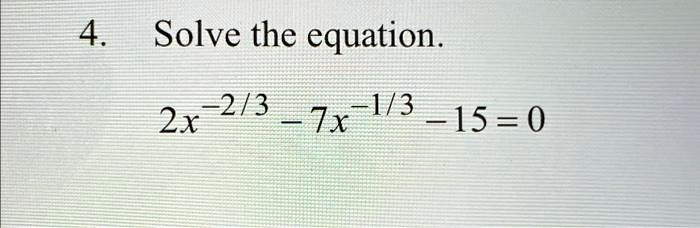
The Correct Answer and Explanation is:
To solve the equation
2x−23−7x−13−15=02x^{-\frac{2}{3}} – 7x^{-\frac{1}{3}} – 15 = 0
we begin by simplifying it using substitution.
Let
y=x−13soy2=x−23.y = x^{-\frac{1}{3}} \quad \text{so} \quad y^2 = x^{-\frac{2}{3}}.
This transforms the original equation into a quadratic form:
2y2−7y−15=0.2y^2 – 7y – 15 = 0.
Apply the quadratic formula:
y=−(−7)±(−7)2−4(2)(−15)2(2)=7±49+1204=7±134.y = \frac{-(-7) \pm \sqrt{(-7)^2 – 4(2)(-15)}}{2(2)} = \frac{7 \pm \sqrt{49 + 120}}{4} = \frac{7 \pm 13}{4}.
So,
y=204=5ory=−64=−1.5.y = \frac{20}{4} = 5 \quad \text{or} \quad y = \frac{-6}{4} = -1.5.
Now back-substitute for xx. Since y=x−1/3y = x^{-1/3}, then
x=y−3.x = y^{-3}.
For y=5y = 5, we get
x=5−3=1125.x = 5^{-3} = \frac{1}{125}.
For y=−1.5y = -1.5,
x=(−1.5)−3=−13.375=−827.x = (-1.5)^{-3} = \frac{-1}{3.375} = \frac{-8}{27}.
Final answer:
x=1125,x=−827.\boxed{x = \frac{1}{125}, \quad x = \frac{-8}{27}}.
Explanation: The given equation involves negative fractional exponents. These types of problems often become more manageable when you use substitution to turn them into a simpler form. In this case, substituting x−1/3x^{-1/3} with a new variable allowed us to reduce the original equation into a quadratic, which can be solved easily using the quadratic formula. The roots of the quadratic are then transformed back by reversing the substitution. Since x−1/3=yx^{-1/3} = y, solving for xx requires taking the reciprocal and cubing, which is straightforward. This method avoids directly manipulating the complex fractional exponents and illustrates a key strategy in algebra—transforming a challenging expression into a solvable form through substitution. It also shows the importance of carefully reversing the steps after solving the simpler version. Each algebraic move maintains the equivalence of the expressions while making the math more tractable. This problem also reinforces how exponents and roots interact, particularly in cases involving reciprocals of cube roots. The final solutions represent the only values of xx for which the original equation holds true.