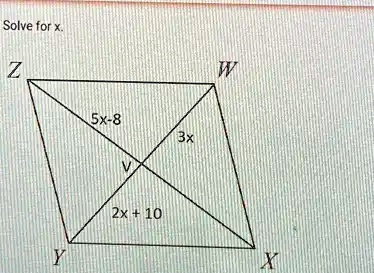
Solve for x.
The Correct Answer and Explanation is:
The correct answer is x = 6.
Explanation
The image provided shows a quadrilateral ZWXY with its two diagonals, ZX and WY, intersecting at a central point V. Based on the visual characteristics, the figure is a parallelogram. A defining property of a parallelogram is that its diagonals bisect each other. This means that the point of intersection, V, is the midpoint of each diagonal, effectively cutting each diagonal into two equal halves.
For the diagonal running from Z to X, this property means that the length of the segment ZV must be equal to the length of the segment VX. The problem gives us algebraic expressions for the lengths of these two segments:
The length of ZV is given as 5x – 8.
The length of VX is given as 2x + 10.
To find the value of x, we can set these two expressions equal to each other, forming a linear equation:
5x – 8 = 2x + 10
Now, we can solve this equation for x. The first step is to collect the terms containing x on one side of the equation. We can do this by subtracting 2x from both sides:
(5x – 2x) – 8 = (2x – 2x) + 10
3x – 8 = 10
Next, we need to isolate the term with x by moving the constant terms to the other side. We can achieve this by adding 8 to both sides of the equation:
3x – 8 + 8 = 10 + 8
3x = 18
Finally, to solve for x, we divide both sides of the equation by the coefficient of x, which is 3:
3x / 3 = 18 / 3
x = 6
Therefore, the value of x is 6. We can verify this solution by plugging x = 6 back into the original expressions for the segments:
Length of ZV = 5(6) – 8 = 30 – 8 = 22.
Length of VX = 2(6) + 10 = 12 + 10 = 22.
Since both segments have the same length of 22, our value for x is correct. The information for segment WV, 3x, is consistent with the properties of a parallelogram but is not needed to find x