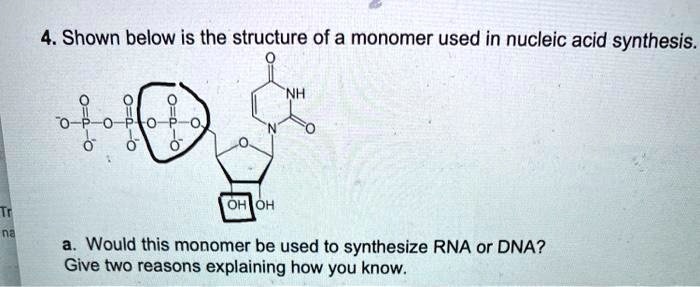
Shown below is the structure of a monomer used in nucleic acid synthesis_ OH OH Would this monomer be used to synthesize RNA or DNA? Give two reasons explaining how you know.
The Correct Answer and Explanation is:
This monomer would be used to synthesize RNA.
There are two distinct structural features in the provided molecule that confirm it is a precursor for RNA synthesis rather than DNA synthesis.
The first reason is the structure of the pentose sugar. Nucleic acids are built from five-carbon sugars. In the monomer shown, the sugar has hydroxyl (-OH) groups on both the 2′ (two-prime) and 3′ (three-prime) carbons of the ring. This specific sugar is called ribose. The presence of the 2′-hydroxyl group is the defining characteristic of the sugar backbone of ribonucleic acid (RNA). In contrast, the sugar used in deoxyribonucleic acid (DNA) is deoxyribose, which, as its name implies, is “deoxygenated” at the 2′ position. It has only a hydrogen atom (-H) at the 2′ carbon, lacking the hydroxyl group found in ribose. This structural difference makes RNA more chemically reactive and less stable than DNA, which is suitable for its role as a temporary genetic messenger.
The second reason is the identity of the nitrogenous base. The base attached to the sugar is uracil (U). Uracil is a pyrimidine base that is one of the four standard nucleobases in the code of RNA; the other three are adenine (A), guanine (G), and cytosine (C). DNA uses a different set of bases. While it also contains adenine, guanine, and cytosine, it uses thymine (T) in place of uracil. Thymine is structurally very similar to uracil, differing only by the presence of a methyl group on its ring. This methylation is biologically significant as it helps cells distinguish between a legitimate part of the DNA sequence and uracil that might arise from the spontaneous deamination of cytosine, a common form of DNA damage.
In summary, the molecule shown is uridine triphosphate (UTP). The presence of both the ribose sugar (with its 2′-hydroxyl group) and the nitrogenous base uracil are definitive indicators that this monomer is a building block for RNA, not DNA.