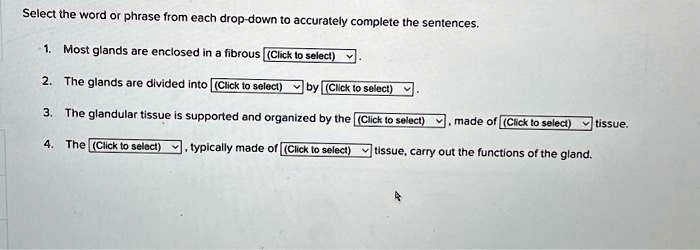
Select the word or phrase from each drop-down to accurately complete the sentences. 1. Most glands are enclosed in a fibrous (Click to select) 2. The glands are divided into (Click to select) by (Click to select) 3. The glandular tissue is supported and organized by the (Click to select), made of (Click to select) tissue. 4. The (Click to select), typically made of (Click to select) tissue, carry out the functions of the gland.
The Correct Answer and Explanation is:
Here are the correctly completed sentences:
- Most glands are enclosed in a fibrous capsule.
- The glands are divided into lobes by septa.
- The glandular tissue is supported and organized by the stroma, made of connective tissue.
- The parenchyma, typically made of epithelial tissue, carry out the functions of the gland.
Explanation
Glands are complex organs with a highly organized internal structure that can be separated into supportive and functional components. Understanding this framework is key to understanding how glands operate.
First, to protect the delicate internal tissues and provide a defined boundary, most glands are surrounded by a tough, fibrous capsule. This outer layer is composed of dense connective tissue and serves as the primary structural container for the organ.
From this external capsule, extensions of connective tissue called septa penetrate into the gland’s interior. These septa act as partitions, dividing the gland into larger functional compartments known as lobes. This division helps to organize the gland and provides a pathway for blood vessels, nerves, and ducts to reach the inner regions. The lobes are often further subdivided into smaller units called lobules.
Within each lobe and lobule, a finer internal framework called the stroma provides support. The stroma is a network made of connective tissue, typically loose or reticular tissue, that surrounds and underpins the functional cells. This supportive meshwork is not passive; it is crucial for housing the blood vessels that nourish the gland and the nerves that control its activity.
The functional component of the gland, which performs the synthesis and secretion, is known as the parenchyma. This part consists of specialized epithelial tissue. These epithelial cells are the workhorses of the gland, producing hormones, enzymes, mucus, or other secretions. The organized arrangement of the parenchyma, supported by the stroma and contained within the capsule, allows the gland to function effectively as a complete organ.