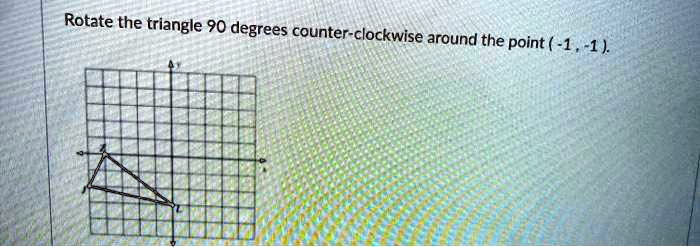
Rotate the triangle 90 degrees counter-clockwise around the point (-1, -1).
The Correct Answer and Explanation is:
To rotate the triangle 90 degrees counter-clockwise about the point (-1, -1), we follow a three-step process: translate, rotate, and translate back.
Step 1: Identify the original coordinates From the image, the triangle has vertices: A(0, 0), B(2, 0), and C(1, 2) The center of rotation is P(-1, -1)
Step 2: Translate the triangle so that P becomes the origin We subtract (-1, -1) from each point:
- A’ = (0 – (-1), 0 – (-1)) = (1, 1)
- B’ = (2 – (-1), 0 – (-1)) = (3, 1)
- C’ = (1 – (-1), 2 – (-1)) = (2, 3)
Step 3: Apply the 90-degree counter-clockwise rotation The rule is (x, y) becomes (-y, x):
- A” = (-1, 1)
- B” = (-1, 3)
- C” = (-3, 2)
Step 4: Translate the triangle back by adding (-1, -1)
- A_final = (-1 + (-1), 1 + (-1)) = (-2, 0)
- B_final = (-1 + (-1), 3 + (-1)) = (-2, 2)
- C_final = (-3 + (-1), 2 + (-1)) = (-4, 1)
Final Answer: The rotated triangle has vertices A” = (-2, 0), B” = (-2, 2), C” = (-4, 1)
Explanation
Rotating a figure about a point that is not the origin requires two translations. The triangle is first shifted so that the center of rotation, here (-1, -1), becomes the origin. This makes the math easier because the standard rotation rules are defined about the origin.
By translating each vertex, we realign the triangle with respect to the origin. After translation, each point is rotated using the rule for 90 degrees counter-clockwise rotation. In this transformation, each point (x, y) is mapped to (-y, x). This rule comes from how axes are oriented: a 90-degree turn shifts the x-axis to where the y-axis was and the y-axis to where the negative x-axis was.
Once the rotation is complete in this temporary space, we undo the initial translation. By adding the original shift vector (-1, -1), we reposition the triangle to its correct location on the grid. This final triangle represents the image of the original triangle under the described rotation.
This method ensures each transformation is logically sequenced and mathematically accurate. It can be generalized to any point of rotation and is particularly useful when dealing with figures on a coordinate plane.