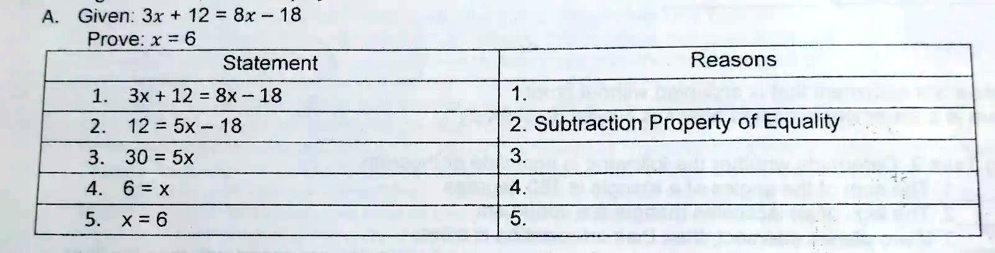
The Correct Answer and Explanation is:
Here are the correct reasons for the blank steps in the proof.
- Given
- Addition Property of Equality
- Division Property of Equality
- Symmetric Property of Equality
Explanation
This table presents a two-column proof, a formal way of solving an algebraic equation where each step (Statement) is justified by a mathematical rule or property (Reason). The goal is to demonstrate logically how to get from the initial equation to the final solution.
Step 1: Given
The first line of any proof always states the information that is provided at the beginning of the problem. The statement 3x + 12 = 8x – 18 is the initial equation we are asked to solve, so the reason is “Given”.
Step 2: Subtraction Property of Equality
The proof moves from 3x + 12 = 8x – 18 to 12 = 5x – 18. This is achieved by subtracting 3x from both sides of the equation to begin isolating the variable x. The Subtraction Property of Equality states that if you subtract the same quantity from both sides of an equation, the equality remains true.
Step 3: Addition Property of Equality
To get from 12 = 5x – 18 to 30 = 5x, we need to eliminate the -18 on the right side. This is done by adding 18 to both sides of the equation (12 + 18 = 30 and 5x – 18 + 18 = 5x). The Addition Property of Equality justifies this step, as it allows adding the same number to both sides without changing the equation’s validity.
Step 4: Division Property of Equality
The statement 30 = 5x is simplified to 6 = x to solve for a single x. This is accomplished by dividing both sides of the equation by the coefficient of x, which is 5. The Division Property of Equality states that you can divide both sides of an equation by the same non-zero number, and the equality will be preserved.
Step 5: Symmetric Property of Equality
The final step rewrites 6 = x as x = 6. While mathematically identical, this places the variable on the left side, which is the conventional format for presenting a solution. This step is justified by the Symmetric Property of Equality, which states that if a = b, then it is also true that b = a. This property allows for the reordering of the two sides of an equation