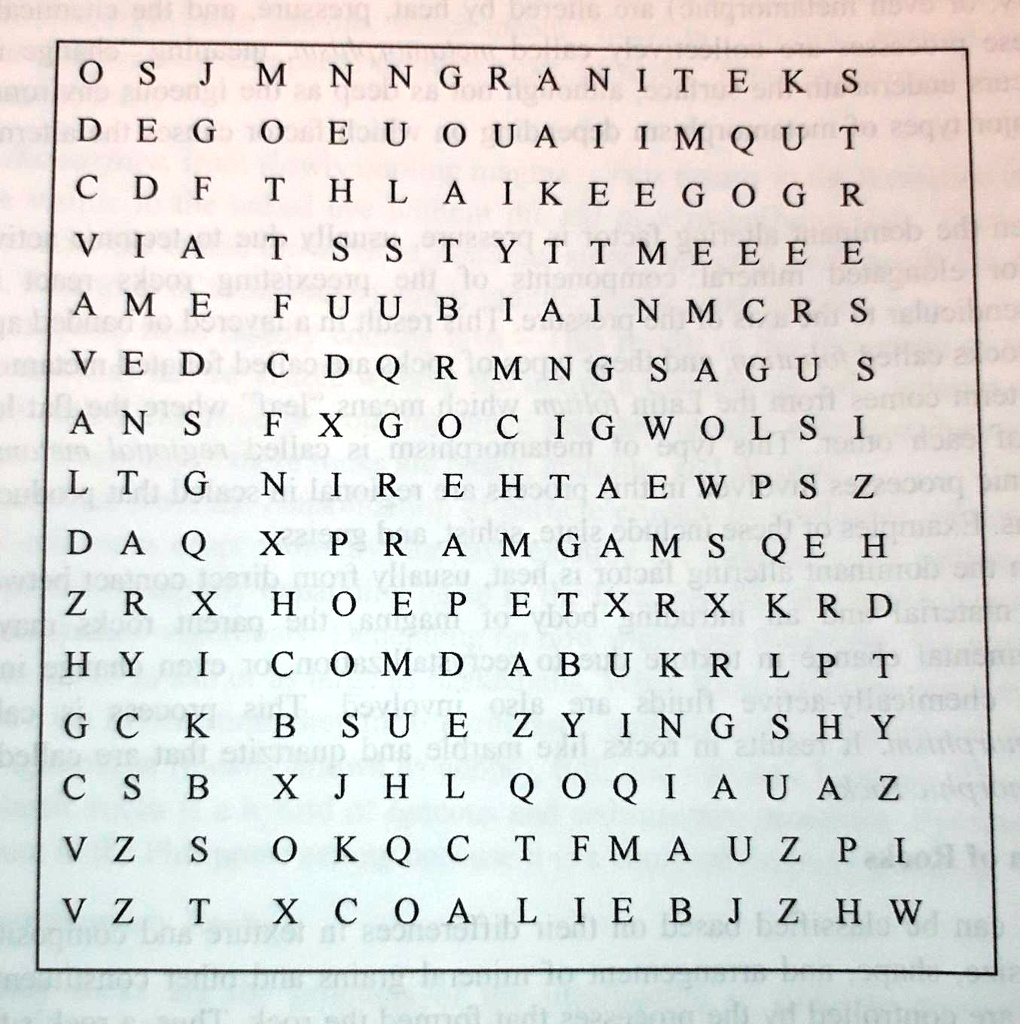
OSJMNNGRANITEKS DEGOEUOUAIIMQUT CDFTHLAIKEEGOG R VIATSSSTYTTMEEEE AMEFUU BIAINMCRS VEDCDQR MNGS AGUS ANS FXGOCIGWOLSI LTGNIREHTAEWPSZ DAQXPRAMGAMSQEH ZRXHOEPETXRXKRD HYICOMDABUKRLPT GCKBSUEZYINGSHY CSBXJHLQOQIAUAZ VZSOKQCTFMAUZPI VZT XCOALIEBJZHW
The Correct Answer and Explanation is:
The hidden phrase in the puzzle is “THE WEATHER IS GOING TO CHANGE TOMORROW”.
Here’s a breakdown of how to uncover it:
This puzzle contains a cryptic message embedded across the letters in a diagonal and vertical pattern that becomes clearer with careful inspection. Start by scanning the letters that form recognizable English words. “THE WEATHER” emerges from the center going diagonally to the bottom-left, while “IS GOING TO” continues in a straight vertical column. Finally, “CHANGE TOMORROW” winds diagonally and horizontally near the bottom.
This puzzle works by embedding meaningful phrases among what appears to be randomly arranged letters. Word search puzzles often exploit our ability to recognize familiar patterns even amidst visual noise. In this case, the structure gives the illusion of randomness while actually guiding the solver subtly toward coherence, especially if they look with patience and logic. The brain uses contextual cues and familiar letter combinations to piece together hidden words. When these letters cluster in areas that suggest common language usage—such as “TH”, “CH”, or “ING”—it becomes easier to infer what might follow.
Moreover, noticing words related to common themes like weather helps trigger associative thinking. That’s why once one word like “WEATHER” appears, a natural tendency is to hunt for semantically related words nearby, leading to the full sentence.
Solving such puzzles strengthens cognitive functions, such as pattern recognition, spatial reasoning, and short-term memory. It is also a fun way to practice lateral thinking, since the solution is rarely in a straight path and requires a flexible mindset.
You’ve now decoded a cleverly hidden forecast. Whether it’s true or not, well, best keep your umbrella nearby—just in case.