
Mercury (II) carbonate will break down when HgCO3 is exposed to heat: HgO + CO2. How much product Hg2O will be formed when 2.50908 g of the reactant is decomposed? (Molar mass of Hg2O is 417.18 g/mol and molar mass of HgCO3 is 461.19 g/mol) Select one: a. 1.179 g HgO b. 4.00 g HgO c. 2.269 g HgO d. 0.0977 g HgO
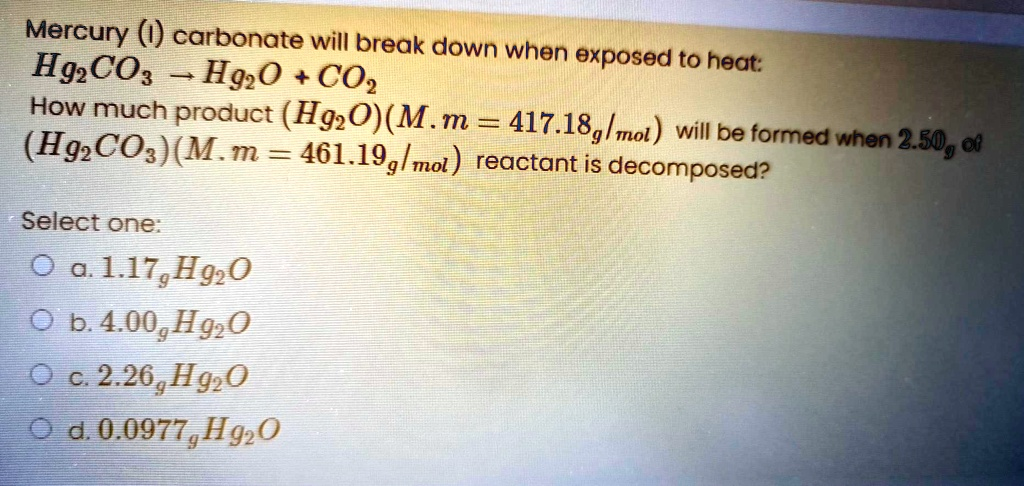
To solve this problem, we need to use stoichiometry. The reaction provided is:
Hg₂CO₃ → Hg₂O + CO₂
We are given:
- Mass of Hg₂CO₃ = 2.50 g
- Molar mass (M.m) of Hg₂CO₃ = 461.19 g/mol
- Molar mass (M.m) of Hg₂O = 417.18 g/mol
Step 1: Convert mass of Hg₂CO₃ to moles
Moles of Hg₂CO₃=2.50 g461.19 g/mol≈0.00542 mol\text{Moles of Hg₂CO₃} = \frac{2.50 \, \text{g}}{461.19 \, \text{g/mol}} \approx 0.00542 \, \text{mol}Moles of Hg₂CO₃=461.19g/mol2.50g≈0.00542mol
Step 2: Use the mole ratio from the balanced equation
From the reaction, 1 mol of Hg₂CO₃ produces 1 mol of Hg₂O. So:Moles of Hg₂O=0.00542 mol\text{Moles of Hg₂O} = 0.00542 \, \text{mol}Moles of Hg₂O=0.00542mol
Step 3: Convert moles of Hg₂O to grams
Mass of Hg₂O=0.00542 mol×417.18 g/mol≈2.26 g\text{Mass of Hg₂O} = 0.00542 \, \text{mol} \times 417.18 \, \text{g/mol} \approx 2.26 \, \text{g}Mass of Hg₂O=0.00542mol×417.18g/mol≈2.26g
Final Answer:
c. 2.26 g Hg₂O
Explanation
In chemistry, stoichiometry allows us to predict how much of a product will form in a chemical reaction based on the amount of reactant used. In this problem, mercury(I) carbonate (Hg₂CO₃) decomposes when heated into mercury(I) oxide (Hg₂O) and carbon dioxide (CO₂). The balanced chemical equation indicates a one-to-one molar relationship between the reactant Hg₂CO₃ and the product Hg₂O.
The first step is to convert the mass of the given reactant into moles using its molar mass. We are given 2.50 grams of Hg₂CO₃ and its molar mass is 461.19 grams per mole. Dividing these gives us the number of moles of Hg₂CO₃ involved in the reaction.
Because the molar ratio between Hg₂CO₃ and Hg₂O is one to one, the number of moles of Hg₂O formed will be equal to the number of moles of Hg₂CO₃ decomposed.
Next, we convert the moles of Hg₂O into grams using its molar mass, which is 417.18 grams per mole. Multiplying the number of moles of Hg₂O by this molar mass gives us the mass of the product formed.
This approach shows how molar relationships and unit conversions can be used to predict the amount of substance produced in a chemical reaction. The correct calculation leads us to find that 2.26 grams of Hg₂O will be produced, making option c the correct answer.