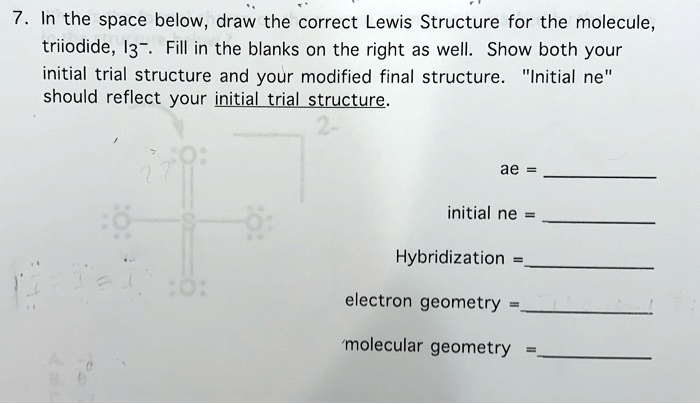
In the space below, draw the correct Lewis Structure for the molecule, triiodide, I3-. Fill in the blanks on the right as well: Show both your initial trial structure and your modified final structure: Initial ne should reflect your initial trial structure: ae initial ne Hybridization electron geometry molecular geometry
The Correct Answer and Explanation is:
Here are the completed answers for the question about the triiodide ion (I₃⁻).
Drawings:
Initial Trial Structure:
This structure represents the initial connectivity of the atoms before the distribution of all valence electrons.
I — I — I
Modified Final Structure:
This is the correct and most stable Lewis structure, showing all valence electrons as lone pairs or bonding pairs.Generated code
..       ..       ..
[ :Ï —  Ï  — :Ï: ]⁻
  ..     |     ..
         ..
In the final structure, each terminal iodine atom has 3 lone pairs, and the central iodine atom has 3 lone pairs.
Filled Blanks:
ae = 22
initial ne = 24
Hybridization = sp³d
electron geometry = trigonal bipyramidal
molecular geometry = linear
Explanation
The correct Lewis structure and properties of the triiodide ion (I₃⁻) are determined through a systematic process.
- Available Electrons (ae): First, we calculate the total number of valence electrons available for bonding. Each iodine (I) atom, being in Group 17, has 7 valence electrons. Since there are three iodine atoms, this gives us 3 x 7 = 21 electrons. The ion has a negative one charge, which means we add one extra electron. Therefore, the total available electrons (ae) are 21 + 1 = 22.
- Initial Needed Electrons (initial ne): For the initial trial structure, we assume that all atoms will obey the octet rule to achieve stability. Each of the three iodine atoms would need 8 electrons. Thus, the total needed electrons (initial ne) would be 3 x 8 = 24. The discrepancy between the needed (24) and available (22) electrons suggests that the simple octet rule will be violated, and one atom must have an expanded octet.
- Lewis Structure Construction: We start by connecting the three iodine atoms with single bonds (I-I-I), using 4 of the 22 available electrons. We then distribute the remaining 18 electrons as lone pairs, starting with the outer (terminal) atoms. Each terminal iodine receives 6 electrons (3 lone pairs) to complete its octet. This uses 12 more electrons. The final 6 electrons are placed on the central iodine atom as 3 lone pairs. In this final structure, the central iodine has 2 bonding pairs and 3 lone pairs, for a total of 10 valence electrons (an expanded octet, which is permissible for elements in period 3 and below). The formal charge on the central atom is -1, while the terminal atoms are neutral, which is the most stable arrangement.
- VSEPR Theory and Geometry: The central iodine atom has 5 electron domains (2 bonding pairs + 3 lone pairs), giving it a steric number of 5. This corresponds to a trigonal bipyramidal electron geometry. According to VSEPR theory, to minimize repulsion, the three lone pairs occupy the equatorial positions, while the two bonding pairs occupy the axial positions. This arrangement results in a linear molecular geometry, with a bond angle of 180°.
- Hybridization: The hybridization of the central atom is determined by its number of electron domains. For 5 electron domains, the atom utilizes one s, three p, and one d orbital, resulting in sp³d hybridization.