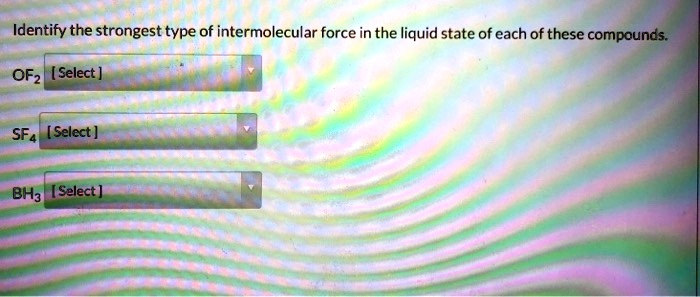
Identify the strongest type of intermolecular force in the liquid state of each of these compounds: OF2 Select ] SF4 Select ] BH3 Select ]
The Correct Answer and Explanation is:
Here are the strongest intermolecular forces for each compound:
OF₂: Dipole-dipole forces
SF₄: Dipole-dipole forces
BH₃: London dispersion forces
Explanation
To identify the strongest intermolecular force (IMF) for a compound, we must first determine its molecular geometry and polarity. The three main types of IMFs, from strongest to weakest, are hydrogen bonding, dipole-dipole forces, and London dispersion forces (LDF). All molecules experience LDF, but polar molecules also have stronger dipole-dipole forces. Hydrogen bonding is a special, very strong type of dipole-dipole force.
OF₂ (Oxygen Difluoride):
The Lewis structure for OF₂ shows a central oxygen atom bonded to two fluorine atoms, with two lone pairs of electrons on the oxygen. According to VSEPR theory, the four electron domains (two bonding, two lone pairs) arrange themselves in a tetrahedral electron geometry, resulting in a bent or V-shaped molecular geometry. Fluorine is more electronegative than oxygen, creating polar O-F bonds. Because of the asymmetrical bent shape, these bond dipoles do not cancel out, making the entire OF₂ molecule polar. Since it is a polar molecule but does not contain hydrogen bonded to N, O, or F, the strongest intermolecular force it experiences is dipole-dipole forces.
SF₄ (Sulfur Tetrafluoride):
The central sulfur atom in SF₄ is bonded to four fluorine atoms and has one lone pair of electrons. This gives it five electron domains, leading to a trigonal bipyramidal electron geometry. The molecular geometry, which accounts for the lone pair, is a seesaw shape. The S-F bonds are highly polar due to the large electronegativity difference between sulfur and fluorine. The asymmetrical seesaw geometry prevents these bond dipoles from canceling, so SF₄ is a polar molecule. As a polar molecule without hydrogen bonding, its strongest intermolecular force is dipole-dipole forces.
BH₃ (Borane):
In BH₃, the central boron atom is bonded to three hydrogen atoms and has no lone pairs. With three bonding domains, VSEPR theory predicts a trigonal planar molecular geometry. In this symmetrical arrangement, the B-H bonds are positioned 120 degrees apart. Even if there were a slight polarity in the B-H bonds, their symmetrical arrangement would cause the bond dipoles to cancel each other out completely. Therefore, BH₃ is a nonpolar molecule. The only intermolecular forces present in nonpolar molecules are London dispersion forces, making them the strongest type for BH₃.thumb_upthumb_down