Unit 1 Given that angle g measures 117∘, what is the measure of angle
The Correct Answer and Explanation is:
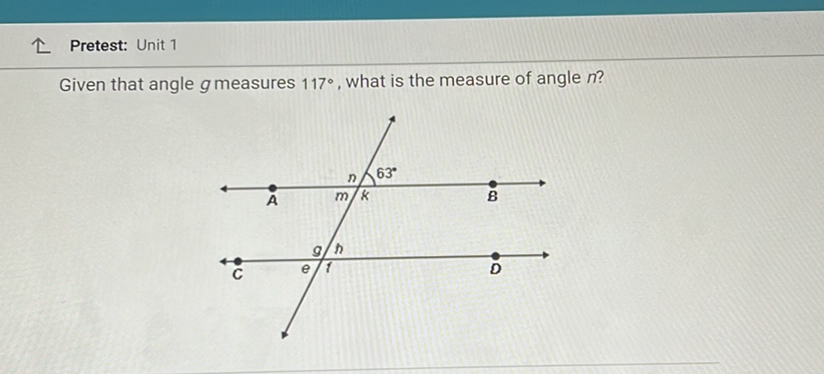
To find the measure of angle n, we are given that angle g is 117°. From the diagram, we see two parallel lines intersected by a transversal, which creates several corresponding, alternate interior, and vertical angles.
Angle g and angle n are alternate interior angles. Alternate interior angles are congruent when the lines are parallel, meaning they have the same measure.
Therefore:∠n=∠g=117∘\angle n = \angle g = 117^\circ∠n=∠g=117∘
Explanation
This problem involves identifying relationships between angles formed by a transversal intersecting two parallel lines. When a transversal crosses two parallel lines, several pairs of angles are created. These angle pairs include corresponding angles, alternate interior angles, alternate exterior angles, and consecutive interior angles. Each pair has specific properties regarding their measures.
In this diagram, the two horizontal lines (AB and CD) are parallel, and a slanted line cuts across them. This slanted line acts as the transversal. Angle g is located on the lower parallel line and to the right of the transversal, while angle n is on the upper parallel line and to the left of the transversal. These two angles are positioned on opposite sides of the transversal and between the two parallel lines. By definition, angles in this position are alternate interior angles.
Alternate interior angles have an important property: they are congruent. That means they have equal measures when the lines being crossed are parallel. Since the problem states that angle g measures 117°, and angle n is its alternate interior angle, angle n must also measure 117°.
Understanding angle relationships is a foundational skill in geometry. Recognizing alternate interior angles and their properties allows us to solve problems involving parallel lines and transversals without needing to measure every angle. Knowing that these angles are congruent helps us deduce the measure of one angle when another is known.
Thus, by using this reasoning, we confidently conclude that the measure of angle n is:117∘\boxed{117^\circ}117∘