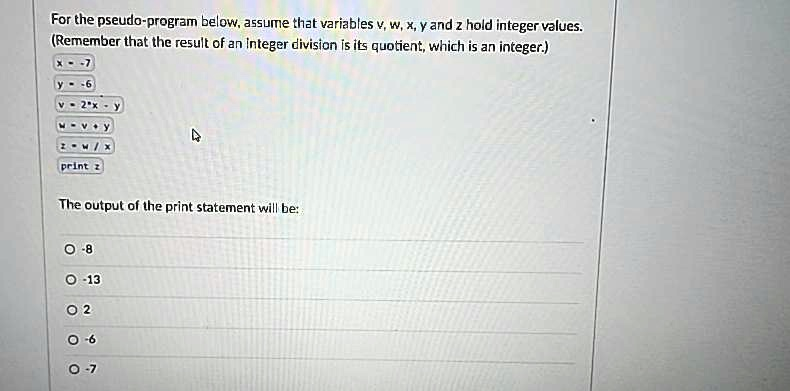
For the pseudo-program below, assume that variables v, w, x, y and z hold integer values. (Remember that the result of an integer division is its quotient, which is an integer.) x <- 7 y <- 6 v <- 2*x – y w <- v + y z <- w / x print z The output of the print statement will be: -8 -13 2 -6 -7
The Correct Answer and Explanation is:
The correct answer is 2.
To determine the final output, we must trace the execution of the pseudo-program step by step, keeping track of the value of each variable. The problem specifies that all variables hold integer values and that division results in an integer quotient, meaning any fractional part is discarded.
- x <- 7: The variable x is initialized with the integer value 7.
- Current values: x = 7
- y <- -6: The variable y is assigned the integer value -6.
- Current values: x = 7, y = -6
- v <- 2*x – y: The program calculates a value for v. We substitute the current values of x and y into the expression: v <- 2 * 7 – (-6). Following the standard order of operations, we perform multiplication before subtraction.
- 2 * 7 = 14
- The expression becomes: v <- 14 – (-6).
- Subtracting a negative number is equivalent to adding its positive counterpart, so the calculation is 14 + 6, which equals 20.
- The variable v is assigned the value 20.
- Current values: x = 7, y = -6, v = 20
- w <- v + y: The program calculates a value for w. We use the current values of v (20) and y (-6): w <- 20 + (-6).
- This simplifies to 20 – 6, which equals 14.
- The variable w is assigned the value 14.
- Current values: x = 7, y = -6, v = 20, w = 14
- z <- w / x: The program calculates the final value for z. We substitute the values of w (14) and x (7): z <- 14 / 7.
- This is an integer division. The result of 14 divided by 7 is 2.
- The variable z is assigned the value 2.
- Current values: x = 7, y = -6, v = 20, w = 14, z = 2
- print z: The program outputs the current value stored in the variable z.
The final value of z is 2. line v <- 2 * x – y requires us to substitute the known values of x and y. The expression becomes v <- 2 * (-7) – (-6). Following the standard order of operations, we perform the multiplication first: 2 * (-7) equals -14. The expression simplifies to v <- -14 – (-6). Subtracting a negative number is equivalent to adding its positive counterpart, so the calculation is -14 + 6, which equals -8. The variable v now holds the value -8.
The subsequent line calculates the value for w with the statement w <- v + y. We substitute the current values of v and y: w <- (-8) + (-6). Adding these two negative integers gives us -14. Therefore, the variable w is assigned the value -14.
The final calculation is for the variable z, using the instruction z <- w / x. Substituting the values we have for w and x, we get z <- (-14) / (-7). This is an integer division. The division of a negative number by another negative number results in a positive number. 14 divided by 7 is exactly 2. Thus, z is assigned the integer value 2.
Finally, the print z command is executed, which outputs the current value stored in the variable z. Since z is 2, the program’s output is 2