The Correct Answer and Explanation is:
Here are the correct expressions for the power series representations.
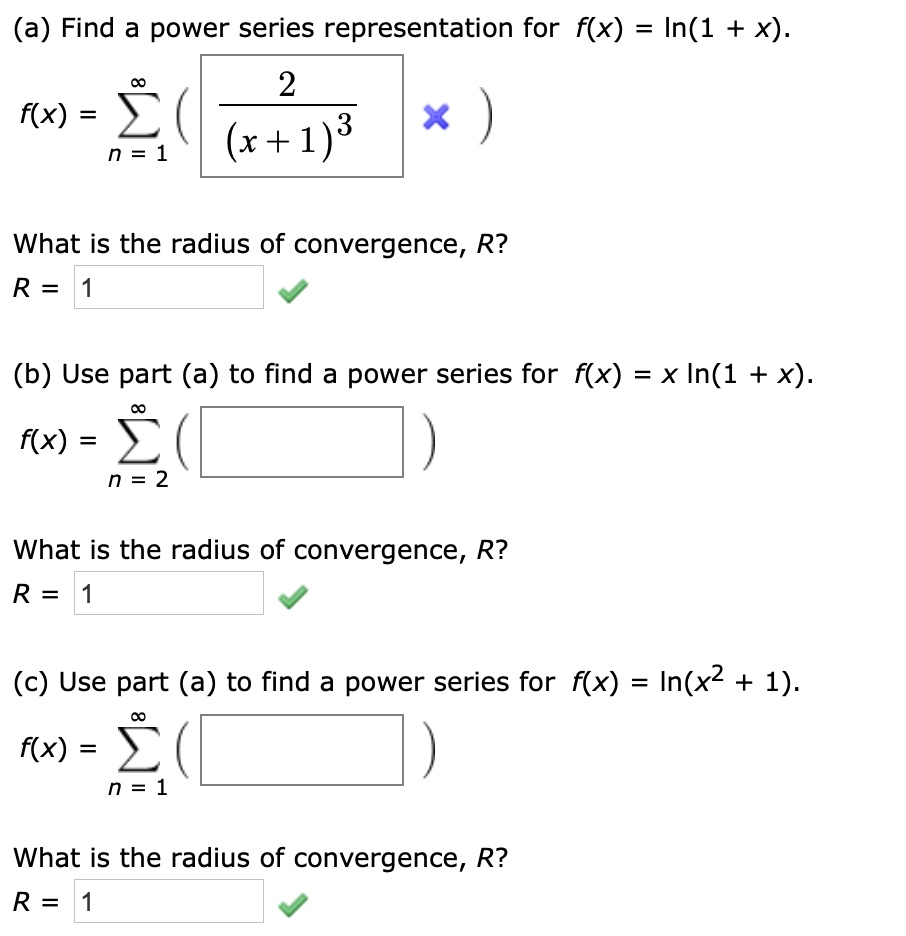
(a) Find a power series representation for f(x) = ln(1 + x).
The general term for the series is:
(-1)^(n-1) * x^n / n
(b) Use part (a) to find a power series for f(x) = x ln(1 + x).
The general term for the series is:
(-1)^(n-2) * x^n / (n-1)
(c) Use part (a) to find a power series for f(x) = ln(x² + 1).
The general term for the series is:
(-1)^(n-1) * x^(2n) / n
Explanation
The solutions for all parts are derived from the basic power series for ln(1+x), which itself comes from the geometric series.
(a) Power series for f(x) = ln(1 + x)
We begin with the geometric series formula: 1/(1−u) = Σ uⁿ for |u|<1. By substituting u = -t, we get the series for 1/(1+t) = Σ (-1)ⁿtⁿ.
Since ln(1+x) is the integral of 1/(1+t) from 0 to x, we can integrate the series term by term:
ln(1+x) = ∫ Σ (-1)ⁿtⁿ dt = Σ ∫ (-1)ⁿtⁿ dt = Σ (-1)ⁿ tⁿ⁺¹/(n+1).
The summation starts from n=0. To match the problem’s format starting from n=1, we re-index the series. This gives the well-known Maclaurin series for ln(1+x):
f(x) = Σ (from n=1 to ∞) [(-1)ⁿ⁻¹xⁿ/n].
The radius of convergence, R, remains 1, the same as the original geometric series.
(b) Power series for f(x) = x ln(1 + x)
To find this series, we multiply the series from part (a) by x:
f(x) = x * [Σ (from n=1 to ∞) (-1)ⁿ⁻¹xⁿ/n] = Σ (from n=1 to ∞) (-1)ⁿ⁻¹xⁿ⁺¹/n.
The problem requires the series to start from n=2. We re-index by setting a new index k=n+1, which means n=k-1. The sum becomes:
Σ (from k=2 to ∞) (-1)⁽ᵏ⁻¹⁾⁻¹xᵏ/(k-1) = Σ (from k=2 to ∞) (-1)ᵏ⁻²xᵏ/(k-1).
Replacing k with n, the term is (-1)ⁿ⁻²xⁿ/(n-1). Multiplying by a polynomial does not change the radius of convergence, so R remains 1.
(c) Power series for f(x) = ln(x² + 1)
We use the series from part (a) and substitute x with x²:
ln(1+u) = Σ (from n=1 to ∞) (-1)ⁿ⁻¹uⁿ/n.
Let u = x².
f(x) = ln(1+x²) = Σ (from n=1 to ∞) (-1)ⁿ⁻¹(x²)ⁿ/n = Σ (from n=1 to ∞) (-1)ⁿ⁻¹x²ⁿ/n.
The original series converges for |u|<1. For this new series, convergence requires |x²|<1, which simplifies to |x|<1. Thus, the radius of convergence R is still 1.