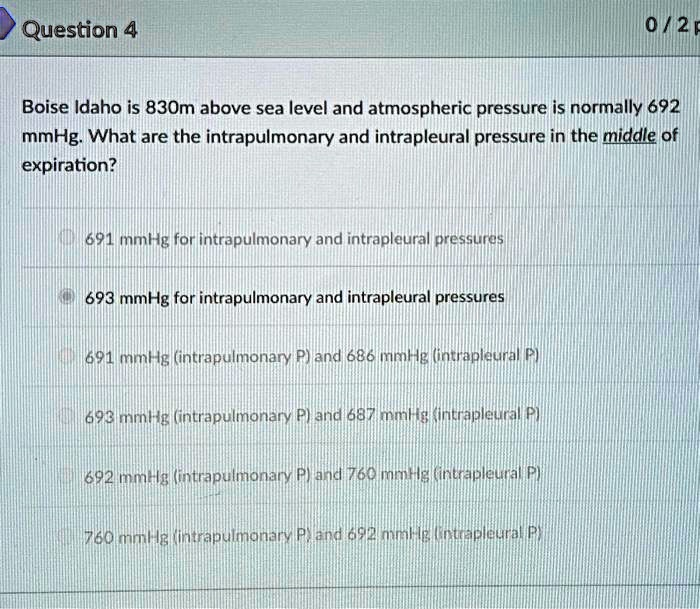
Boise, Idaho is 830 m above sea level and the atmospheric pressure is normally 692 mmHg. What are the intrapulmonary and intrapleural pressures in the middle of expiration? – 691 mmHg for intrapulmonary and intrapleural pressures – 693 mmHg for intrapulmonary and intrapleural pressures – 691 mmHg (intrapulmonary P) and 686 mmHg (intrapleural P) – 693 mmHg (intrapulmonary P) and 687 mmHg (intrapleural P) – 1692 mmHg (intrapulmonary P) and 760 mmHg (intrapleural P) – 760 mmHg (intrapulmonary P) and 692 mmHg (intrapleural P)
The Correct Answer and Explanation is:
The correct answer is: 693 mmHg (intrapulmonary P) and 687 mmHg (intrapleural P)
Explanation:
To determine the correct pressures, we must understand the mechanics of breathing in relation to atmospheric pressure. The provided atmospheric pressure (Patm) in Boise is 692 mmHg, which serves as our baseline reference. Air movement into and out of the lungs is governed by pressure gradients relative to this atmospheric pressure.
First, let’s consider the intrapulmonary pressure (Ppul), which is the pressure inside the alveoli of the lungs. The question asks for the pressure in the middle of expiration. Expiration is the process of air flowing out of the lungs. For air to flow from the lungs to the outside atmosphere, the pressure inside the lungs must be higher than the atmospheric pressure. During quiet, normal expiration, this pressure difference is typically very small, about +1 mmHg relative to the atmosphere. Therefore, the intrapulmonary pressure would be the atmospheric pressure plus this small gradient.
Calculation for Intrapulmonary Pressure (Ppul):
Ppul = Patm + 1 mmHg
Ppul = 692 mmHg + 1 mmHg = 693 mmHg
Next, we must determine the intrapleural pressure (Pip). This is the pressure within the pleural cavity, the space between the lungs and the chest wall. A key principle of respiratory physiology is that the intrapleural pressure is always negative relative to the atmospheric pressure. This negative pressure acts as a suction, keeping the lungs expanded against the chest wall and preventing them from collapsing. During the breathing cycle, this pressure fluctuates. As the chest recoils during expiration, the intrapleural pressure becomes less negative than it was during inspiration. A typical value during quiet expiration is approximately -5 mmHg relative to atmospheric pressure.
Calculation for Intrapleural Pressure (Pip):
Pip = Patm – 5 mmHg
Pip = 692 mmHg – 5 mmHg = 687 mmHg
Combining these results, the intrapulmonary pressure is 693 mmHg and the intrapleural pressure is 687 mmHg during the middle of expiration in Boise. This matches the selected answer choice.ural P)**.
Explanation:
To determine the correct pressures, we must first understand the key principles of respiratory mechanics relative to the given atmospheric pressure.
- Atmospheric Pressure (Patm): The question states that the atmospheric pressure in Boise is 692 mmHg. This is the baseline reference pressure for all other respiratory pressures.
- Intrapulmonary Pressure (Ppul): This is the pressure inside the alveoli of the lungs. Air flows based on pressure gradients. For air to move out of the lungs during expiration, the intrapulmonary pressure must be greater than the atmospheric pressure. During quiet, passive expiration, this pressure is typically about 1 mmHg higher than the atmospheric pressure.
- Calculation: Ppul = Patm + 1 mmHg = 692 mmHg + 1 mmHg = 693 mmHg.
An intrapulmonary pressure of 693 mmHg creates the necessary gradient for air to flow from the lungs (higher pressure) to the outside atmosphere (lower pressure).
- Calculation: Ppul = Patm + 1 mmHg = 692 mmHg + 1 mmHg = 693 mmHg.
- Intrapleural Pressure (Pip): This is the pressure within the pleural cavity, the space between the lungs and the chest wall. This pressure is fundamentally important as it must always be negative relative to the intrapulmonary pressure to keep the lungs from collapsing. It is also normally negative relative to the atmospheric pressure. During the breathing cycle, this pressure fluctuates. At rest (between breaths), it’s about -4 mmHg relative to Patm. During inspiration, it becomes more negative (e.g., -6 mmHg). During expiration, as the chest wall and lungs recoil, the intrapleural pressure becomes less negative, moving from its inspiration value back toward its resting value. In the middle of expiration, a value of approximately -5 mmHg relative to Patm is physiologically accurate.
- Calculation: Pip = Patm – 5 mmHg = 692 mmHg – 5 mmHg = 687 mmHg.
Combining these calculations, in the middle of expiration in Boise, the intrapulmonary pressure is 693 mmHg, and the intrapleural pressure is 687 mmHg. This combination correctly reflects the physiological state where air is leaving the lungs, and the lungs are maintained in an inflated state