Write the formula for the ionic compound formed from each cation and anion cesium and sulfite b: cesium and cyanide
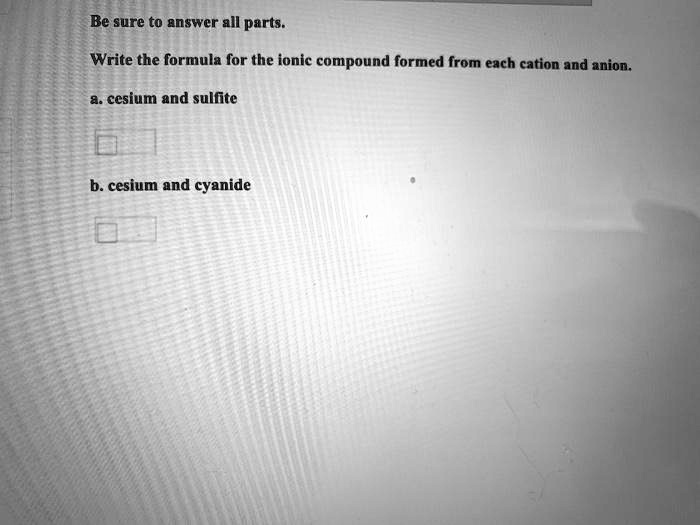
The Correct Answer and Explanation is:
Here are the correct formulas and the explanation.
a. Cs₂SO₃
b. CsCN
To write the chemical formula for an ionic compound, the fundamental principle is to combine the cation (the positive ion) and the anion (the negative ion) in a specific ratio that makes the overall electrical charge of the compound neutral, or zero.
a. Cesium and Sulfite
First, we must identify the chemical symbols and charges of the cation and anion. The cation is cesium. Cesium (Cs) is an alkali metal located in Group 1 of the periodic table. Elements in this group always form ions with a +1 charge. Therefore, the cesium cation is written as Cs⁺.
The anion is sulfite. Sulfite is a polyatomic ion, meaning it is a molecule composed of multiple atoms that carries a net electrical charge. The chemical formula for the sulfite ion is SO₃, and it has a charge of -2. Thus, the sulfite anion is written as SO₃²⁻.
To form a neutral compound, the total positive charge must equal the total negative charge. We have a +1 charge from cesium and a -2 charge from sulfite. To balance these charges, we need two cesium ions for every one sulfite ion. This arrangement gives us a total positive charge of (2 × +1) = +2, which perfectly cancels out the -2 charge of the single sulfite ion. The overall charge becomes (+2) + (-2) = 0. When writing the final formula, the cation is listed first, and the number of ions is shown as a subscript. The correct formula for cesium sulfite is Cs₂SO₃.
b. Cesium and Cyanide
In this part, the cation is again cesium (Cs⁺), with its +1 charge. The anion is cyanide. Cyanide is also a polyatomic ion, with the chemical formula CN and a charge of -1. The cyanide anion is written as CN⁻.
Here, the process of balancing the charges is simpler. The cesium ion has a +1 charge, and the cyanide ion has a -1 charge. Since the charges are equal in magnitude and opposite in sign, they balance each other in a one to one ratio. One Cs⁺ ion is all that is needed to neutralize one CN⁻ ion, resulting in a total charge of (+1) + (-1) = 0. Following the convention of writing the cation before the anion, the chemical formula for cesium cyanide is CsCN. No subscripts are necessary as there is only one of each ion in the formula unit.