Pond water, pond scum, pond water, pond “scum”. Mount a slide of pond water using a cover slip. Prepare 10X and 40X magnification. There could be algae, diatoms, and other multi-cellular animals present. Many microscopic residents are protozoans that prey on the smaller residents. Sketch your observations of the motile organisms and write your comments below. Get a slide of Oscillatoria: This is a type of bacterium that forms colonies with the cells side-by-side. Bacteria are prokaryotic, which means that they have no nucleus or organelles. Some bacteria, like Oscillatoria, have chlorophyll spread throughout their cells, unlike plants which have chlorophyll only inside chloroplasts.
The Correct Answer and Explanation is:
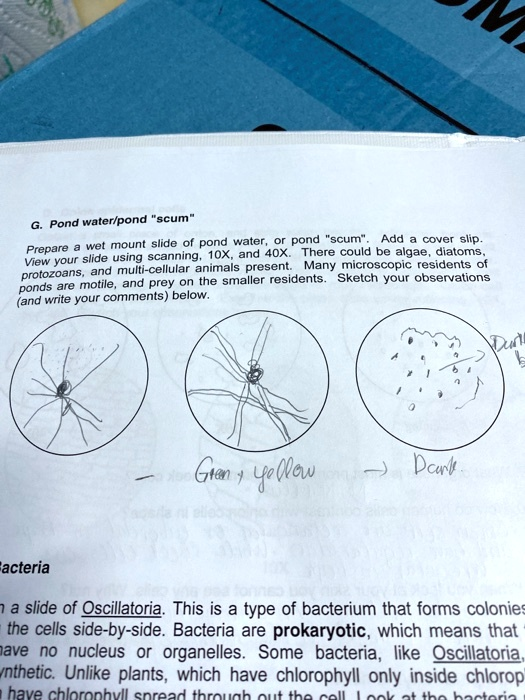
Based on the student’s sketches and notes, the most likely organisms observed are two common types of protozoans found in pond water.
Correct Answer:
The organism sketched in the first two circles is a Heliozoan, also known as a “sun animalcule.” The third sketch likely depicts another protozoan, such water. The first two drawings show a Heliozoan, also known as a “sun animacule,” and the third drawing likely depicts a different type of amoeboid protozoan.
The identification of the first organism as a Heliozoan, possibly from the genus Actinophrys or Actinosphaerium, is strongly supported by the student’s drawing. The sketch accurately shows a central, spherical body with many long, thin, needle like projections radiating outwards. These projections are called axopods, which are specialized pseudopods used by the organism to float and capture prey, such as smaller protists, algae, and bacteria. The student’s note, “Green + yellow,” provides another crucial clue. Many species of Heliozoa contain symbiotic algae called zoochlorellae within their cytoplasm. These algae photosynthesize and provide the Heliozoan with nutrients, which in turn gives the organism a distinct greenish or yellowish color. The combination of the sunburst shape and the observed color makes this identification highly probable.
The third sketch is less detailed but likely represents another protozoan, such as a common amoeba (Amoeba proteus) or a different protist. Its irregular, blob like shape is characteristic of an amoeba, which moves and feeds by extending and retracting lobe shaped pseudopods. The small dots drawn inside the cell probably represent internal structures. Given the note “Dark,” these dots are most likely food vacuoles, which are membrane bound sacs containing ingested food particles that appear as dark spots under a microscope, especially as digestion occurs. The arrow pointing from the Heliozoan to this sketch might simply indicate this was the next organism observed. This sketch fulfills the lab’s goal of observing different microscopic residents, including those that prey on smaller organisms, which is a primary activity of amoebas in pond ecosystems. as an Amoeba or a ciliate like Paramecium.
Explanation:
This biology lab exercise requires the observation and documentation of microscopic life from a pond water sample. The student’s drawings represent a successful observation of typical pond microorganisms.
The first two sketches clearly show an organism with a spherical central body and numerous, thin, radiating projections. This morphology is characteristic of a Heliozoan (meaning “sun animal”). These projections are stiff, needle like pseudopods called axopods. Heliozoans use these axopods to float and, more importantly, to capture prey. Small organisms like bacteria, algae, and other protozoans get stuck to the axopods and are then transported to the central body to be ingested. The student’s note “Green + yellow” is an excellent observation. This coloration can be due to ingested food particles or, very commonly, from symbiotic green algae called zoochlorellae living within the heliozoan’s cytoplasm. This symbiotic relationship provides the heliozoan with nutrients from photosynthesis.
The third drawing is less distinct but shows an irregularly shaped cell with small dots inside, which the student notes as “Dark.” This is likely another type of protozoan. A strong candidate is an Amoeba, a classic pond dweller known for its blob like shape that constantly changes as it moves using its pseudopods. The dots could represent the nucleus and various food vacuoles containing digested material, which can make the organism appear dark or granular under the microscope. Alternatively, it could be a ciliate, such as a Paramecium, which is also motile and a common resident of pond ecosystems. Both possibilities fit the lab’s description of motile, predatory microscopic residents. The student has effectively captured the diversity of protozoan life in their sample.