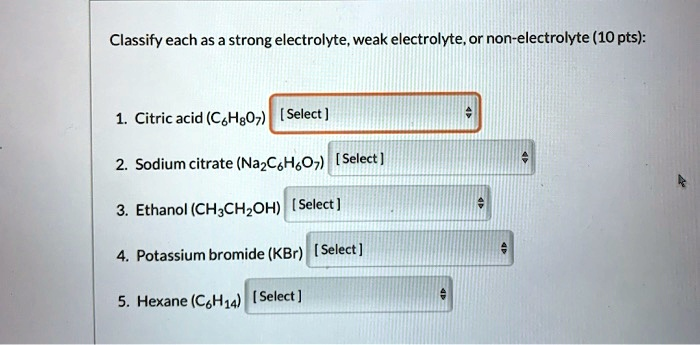
Classify each as a strong electrolyte, weak electrolyte, or non-electrolyte (10 pts): 1. Citric acid (C6H8O7) [Select ] 2. Sodium citrate (Na3C6H5O7) [Select ] 3. Ethanol (C2H6O) [Select ] 4. Potassium bromide (KBr) [Select ] 5. Hexane (C6H14) [Select ]
The Correct Answer and Explanation is:
Based on the principles of chemical electrolytes, here is the classification for each substance:
- Citric acid (C₆H₈O₇): This is a weak acid. Weak acids only partially ionize in water, making them weak electrolytes.
- Sodium citrate (Na₂C₆H₆O₇): This is a salt. Salts containing alkali metals (like sodium, Na⁺) are typically soluble in water and dissociate completely into their ions (in this case, Na⁺ and C₆H₆O₇²⁻). Therefore, it is a strong electrolyte.
- Ethanol (CH₃CH₂OH): This is an alcohol, which is a molecular compound. It dissolves in water but does not ionize (form charged particles). Thus, it is a non-electrolyte.
- Potassium bromide (KBr): This is a soluble ionic salt, formed from an alkali metal (potassium, K⁺) and a halide (bromide, Br⁻). It completely dissociates into K⁺ and Br⁻ ions in water, making it a strong electrolyte.
- Hexane (C₆H₁₄): This is a hydrocarbon, which is a nonpolar molecular compound. It does not dissolve in water and does not produce ions. It is a non-electrolyte.
Here are the answers to fill in the blanks:
- Citric acid (C₆H₈O₇): Weak electrolyte
- Sodium citrate (Na₂C₆H₆O₇): Strong electrolyte
- Ethanol (CH₃CH₂OH): Non-electrolyte
- Potassium bromide (KBr): Strong electrolyte
- Hexane (C₆H₁₄): Non-electrolyte