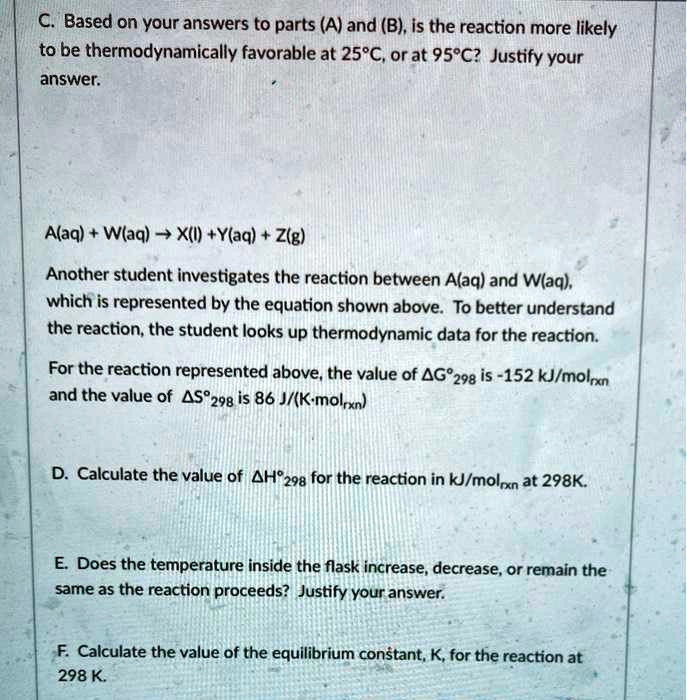
Based on your answers to parts (A) and (B), is the reaction more likely to be thermodynamically favorable at 25°C or at 95°C? Justify your answer: Al(aq) + W(aq) + X() + Y(aq) + Z(g) Another student investigates the reaction between Al(aq) and W(aq), which is represented by the equation shown above. To better understand the reaction, the student looks up thermodynamic data for the reaction. For the reaction represented above, the value of ΔG°298 is -152 kJ/mol and the value of ΔS°298 is 86 J/(K mol). D. Calculate the value of ΔH°298 for the reaction in kJ/mol at 298K. Does the temperature inside the flask increase, decrease, or remain the same as the reaction proceeds? Justify your answer. F. Calculate the value of the equilibrium constant, K, for the reaction at 298K
The Correct Answer and Explanation is:
Here are the answers to the questions based on the provided thermodynamic data.
Part D. Calculate the value of ΔH°₂₉₈ for the reaction in kJ/mol_rxn at 298K.
The value of the standard enthalpy change, ΔH°₂₉₈, is -126.4 kJ/mol.
Part E. Does the temperature inside the flask increase, decrease, or remain the same as the reaction proceeds? Justify your answer.
The temperature inside the flask will increase. This is because the calculated value for the change in enthalpy (ΔH°) is negative, which signifies that the reaction is exothermic. Exothermic reactions release energy, typically in the form of heat, into their surroundings. As the reaction proceeds, this released heat will be absorbed by the solution and the flask, causing their temperature to rise.
Part F. Calculate the value of the equilibrium constant, K, for the reaction at 298 K.
The value of the equilibrium constant, K, is 5.4 x 10²⁶.
Part C. Based on your answers to parts (A) and (B), is the reaction more likely to be thermodynamically favorable at 25°C, or at 95°C? Justify your answer.
The reaction is more likely to be thermodynamically favorable at 95°C.
Explanation
The provided problems can be solved using fundamental principles of chemical thermodynamics, primarily centered around the Gibbs free energy equation.
First, to solve for the standard enthalpy change (ΔH°₂₉₈) in Part D, we use the core thermodynamic relationship: ΔG° = ΔH° – TΔS°. We are given ΔG°₂₉₈ (-152 kJ/mol), T (298 K), and ΔS°₂₉₈ (86 J/(K·mol)). Before calculating, it is crucial to ensure consistent units. We convert ΔS° from J/(K·mol) to kJ/(K·mol) by dividing by 1000, which gives 0.086 kJ/(K·mol). Rearranging the equation to solve for ΔH° gives ΔH° = ΔG° + TΔS°. Plugging in the values: ΔH° = -152 kJ/mol + (298 K * 0.086 kJ/(K·mol)) = -152 kJ/mol + 25.6 kJ/mol = -126.4 kJ/mol.
For Part E, the sign of ΔH° determines the heat flow. Since ΔH° is -126.4 kJ/mol, the reaction is exothermic, releasing heat and thus increasing the flask’s temperature.
For Part C, we analyze how temperature affects Gibbs free energy (ΔG). A more negative ΔG indicates greater thermodynamic favorability. The equation ΔG = ΔH – TΔS shows that when the change in entropy (ΔS) is positive (as it is here, +86 J/(K·mol)), the term “-TΔS” becomes more negative as temperature (T) increases. Since ΔH is already negative, increasing the temperature makes the overall ΔG value even more negative. Therefore, the reaction becomes more favorable at a higher temperature, making 95°C (368 K) the more favorable condition compared to 25°C (298 K).
Finally, to find the equilibrium constant (K) for Part F, we use the equation relating it to standard Gibbs free energy: ΔG° = -RT ln(K). Here, R is the ideal gas constant (8.314 J/(K·mol)). We must convert ΔG° to J/mol: -152 kJ/mol becomes -152,000 J/mol. Rearranging gives ln(K) = -ΔG° / (RT). So, ln(K) = -(-152,000 J/mol) / (8.314 J/(K·mol) * 298 K) ≈ 61.35. To find K, we take the exponent of this value: K = e⁶¹·³⁵ ≈ 5.4 x 10²⁶. This extremely large K value confirms the reaction is highly favorable and proceeds almost to completion under standard conditions