ionic compound magnesium iodine yes strontium potassium yes fluorine oxygen yes potassium oxygen yes Don’t Know Submit
element #1 element #2 Forms ionic compound? empirical formula of ionic compound magnesium iodine yes strontium potassium yes fluorine oxygen yes potassium oxygen yes Don’t Know Submit
The Correct Answer and Explanation is:
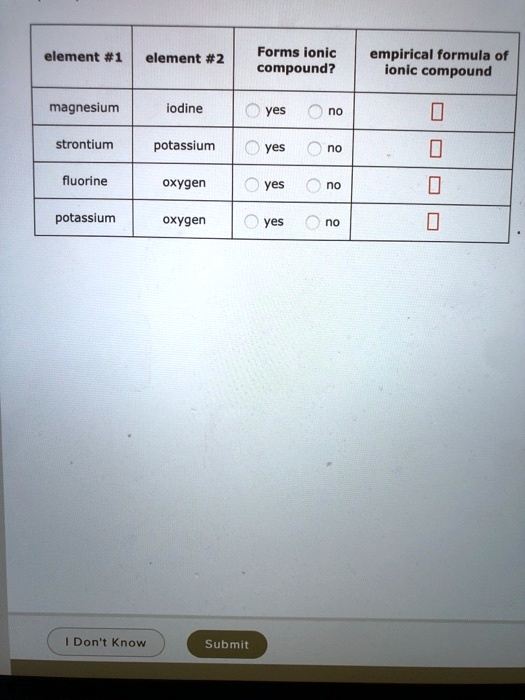
Here is the completed table with the correct answers.
| element #1 | element #2 | Forms ionic compound? | empirical formula of ionic compound |
| magnesium | iodine | yes | MgI₂ |
| strontium | potassium | no | – |
| fluorine | oxygen | no | – |
| potassium | oxygen | yes | K₂O |
Explanation
Ionic compounds are chemical compounds formed through the electrostatic attraction between oppositely charged ions. This type of bonding typically occurs between a metal, which loses electrons to form a positive ion (cation), and a nonmetal, which gains electrons to form a negative ion (anion). A significant difference in electronegativity between the two elements is a key indicator of ionic bonding. The empirical formula of an ionic compound represents the simplest whole-number ratio of ions required to achieve a net charge of zero.
- Magnesium and Iodine: Magnesium (Mg) is an alkaline earth metal in Group 2 of the periodic table, so it readily loses two electrons to form a stable cation with a +2 charge (Mg²⁺). Iodine (I) is a halogen in Group 17, and it gains one electron to form an anion with a -1 charge (I⁻). Because this pair consists of a metal and a nonmetal, they form an ionic compound. To create a neutral compound, the total positive charge must equal the total negative charge. One Mg²⁺ ion requires two I⁻ ions to balance the charge (+2 + 2(-1) = 0). Therefore, the empirical formula is MgI₂.
- Strontium and Potassium: Strontium (Sr) is an alkaline earth metal (Group 2) and potassium (K) is an alkali metal (Group 1). Both are metals and both tend to lose electrons to form positive ions (Sr²⁺ and K⁺). Since like charges repel, they will not form an ionic bond with each other. Instead, metals bond with other metals through metallic bonding, forming an alloy, not a distinct ionic compound with a fixed formula.
- Fluorine and Oxygen: Fluorine (F) and oxygen (O) are both nonmetals located on the upper right side of the periodic table. They have the two highest electronegativity values of all elements. Because their electronegativities are very similar and high, they will share electrons to form a covalent compound (oxygen difluoride, OF₂), rather than transferring electrons to form an ionic compound.
- Potassium and Oxygen: Potassium (K) is an alkali metal (Group 1) that forms a K⁺ ion. Oxygen (O) is a nonmetal (Group 16) that forms an O²⁻ ion. The combination of a metal and a nonmetal with a large electronegativity difference results in an ionic bond. To balance the -2 charge of one oxide ion, two K⁺ ions are needed (2(+1) + (-2) = 0). This results in the empirical formula K₂O.