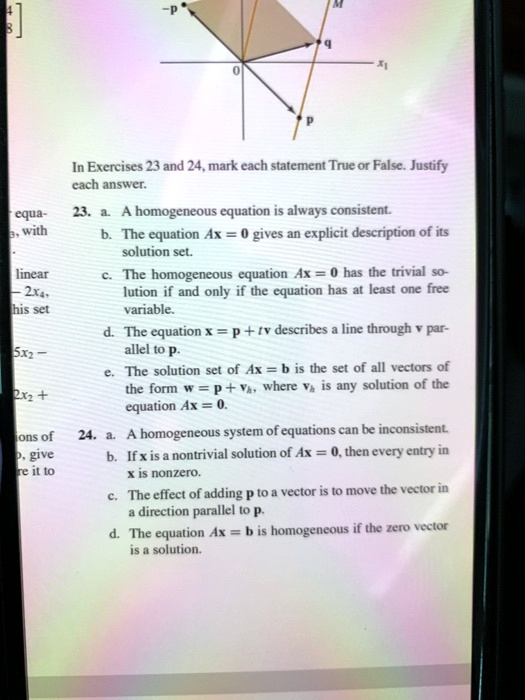
In Exercises 23 and 24, mark each statement True or False. Justify each answer. 1. A homogeneous equation is always consistent. 2. The equation Ax = 0 gives an explicit description of its solution set. 3. The homogeneous equation Ax = 0 has the trivial solution if and only if the equation has at least one free variable. 4. The equation x = p + tv describes a line through a point parallel to p. 5. The solution set of Ax = b is the set of all vectors of the form p + ya, where ya is any solution of the equation Ax = 0. 6. A homogeneous system of equations can be inconsistent. 7. If x is a nontrivial solution of Ax = 0, then every entry in x is nonzero. 8. The effect of adding p to a vector is to move the vector in the direction parallel to p. 9. The equation Ax = b is homogeneous if the zero vector is a solution.
The Correct Answer and Explanation is:
Here are the correct answers and justifications for each statement.
Exercise 23
- True. A homogeneous equation is of the form Ax = 0. It is always consistent because it has at least one solution, the trivial solution, where x is the zero vector. Since A times the zero vector always results in the zero vector, this solution always exists.
- False. The equation Ax = 0 is an implicit description of the solution set. It defines the condition that any solution vector x must satisfy. An explicit description is what you find after solving the system, typically by writing the solution in parametric vector form (e.g., x = t*v for some vector v), which explicitly generates all possible solutions.
- False. A homogeneous equation Ax = 0 always has the trivial solution, regardless of whether there are free variables. The presence of a free variable indicates that the system has nontrivial solutions (solutions other than the zero vector) in addition to the trivial one. The statement incorrectly connects the existence of the trivial solution to the presence of free variables.
- False. The equation x = p + t*v describes a line that passes through the point corresponding to the vector p and is parallel to the direction vector v. The statement incorrectly claims the line is parallel to p.
- True. This is a fundamental theorem in linear algebra. If the equation Ax = b is consistent and has a particular solution p, then the full solution set consists of all vectors of the form p + v_h, where v_h is any solution to the corresponding homogeneous equation Ax = 0. This means the solution set of Ax = b is a translation of the solution set of Ax = 0.
Exercise 24
- False. This statement is the opposite of statement 1. A homogeneous system Ax = 0 is always consistent because the trivial solution (x = 0) is always a possible solution. An inconsistent system is one with no solutions at all.
- False. A nontrivial solution is any nonzero vector x that solves the equation. For x to be nonzero, it only needs to have at least one nonzero entry; the other entries can be zero. For example, x = [1, 0] is a nontrivial vector and could be a solution to some homogeneous system.
- True. Vector addition can be interpreted geometrically. Adding a vector p to another vector v results in a new vector v + p. This operation translates the endpoint of the vector v by the displacement vector p. The movement is in the direction and magnitude of p.
- True. An equation is defined as homogeneous if it is in the form Ax = 0. If the zero vector is a solution to the equation Ax = b, we can substitute x = 0 into the equation. This gives A(0) = b, which simplifies to 0 = b. Therefore, the vector b must be the zero vector, and the equation is Ax = 0, which is homogeneous by definition.