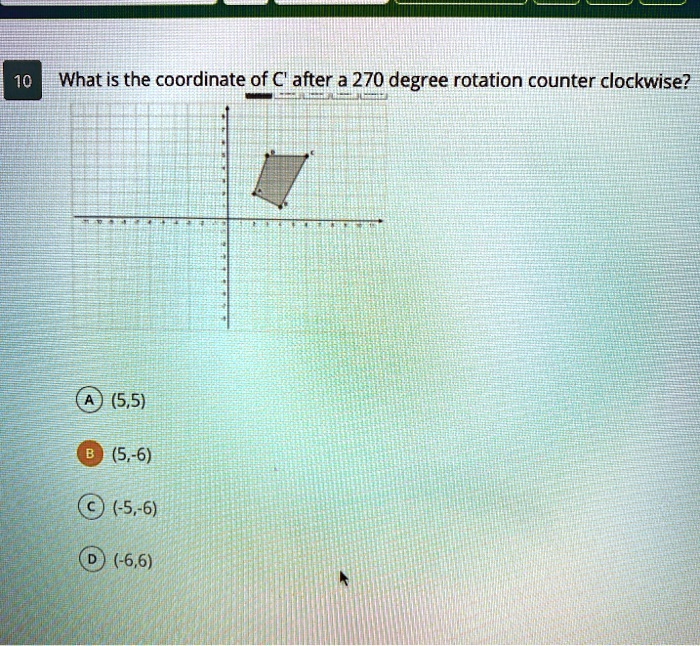
What is the coordinate of C’ after a 270 degree rotation counter clockwise? A) (5,5) B (5,-6) (C) (-5,-6) D) (-6,6)
The Correct Answer and Explanation is:
The correct answer is B (5, -6).
To find the coordinates of C’ after a 270-degree counterclockwise rotation, we first need to identify the original coordinates of point C from the provided graph. By observing the coordinate plane, we can see that point C is located 6 units to the right of the origin along the x-axis and 5 units up along the y-axis. Therefore, the coordinates of point C are (6, 5).
The next step is to apply the rule for a 270-degree counterclockwise rotation about the origin. When a point with coordinates (x, y) is rotated 270 degrees counterclockwise, its new coordinates, which we can call (x’, y’), are determined by the formula (y, -x). This rule indicates that the original y-coordinate becomes the new x-coordinate, and the negative of the original x-coordinate becomes the new y-coordinate.
Now, we apply this rule to our point C (6, 5). In this case, x = 6 and y = 5. Using the rotation formula (y, -x), we substitute the values:
The new x-coordinate (x’) will be the original y-coordinate, which is 5.
The new y-coordinate (y’) will be the negative of the original x-coordinate, which is -6.
This calculation gives us the new coordinates for C’ as (5, -6).
We can also visualize this rotation to confirm the result. Point C (6, 5) is in the first quadrant. A 90-degree counterclockwise rotation would place it in the second quadrant. A 180-degree rotation would move it to the third quadrant. Finally, a 270-degree rotation places it in the fourth quadrant. The coordinates (5, -6) correctly place the point in the fourth quadrant, as points in this quadrant have a positive x-coordinate and a negative y-coordinate.
Comparing our result with the given options, the coordinates (5, -6) match option B