How many protons, electrons, and neutrons does 70Ga3+ have? a. 28 protons, 31 electrons, 42 neutrons b. 6 protons, 31 electrons, 28 neutrons, 70 c. 28 protons, 31 electrons, 39 neutrons d. 31 protons, 28 electrons, 39 neutrons e. 31 protons, 31 electrons, 39 neutrons
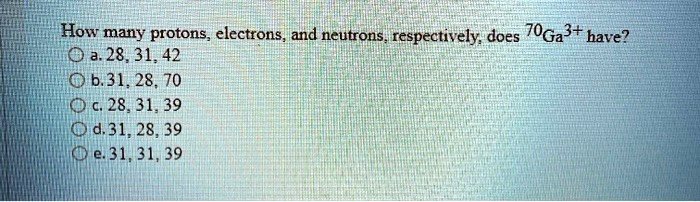
The Correct Answer and Explanation is:
The correct answer is d. 31 protons, 28 electrons, 39 neutrons.
To determine the number of protons, electrons, and neutrons in the ion ⁷⁰Ga³⁺, we need to carefully analyze the information provided in its notation. This notation gives us the element’s symbol, its mass number, and its ionic charge.
First, let’s find the number of protons. The number of protons in an atom or ion is defined by its atomic number (Z). The atomic number is unique to each element and identifies it on the periodic table. The symbol “Ga” represents the element Gallium. By looking at a periodic table, we can find that Gallium has an atomic number of 31. Therefore, any atom or ion of Gallium will always contain 31 protons in its nucleus. The number of protons is the fundamental identity of an element and does not change, regardless of its isotope or charge.
Next, we determine the number of electrons. In a neutral atom, the number of electrons is equal to the number of protons to maintain an overall charge of zero. A neutral Gallium atom would have 31 electrons. However, the species in the question is an ion, indicated by the superscript “3+” on the right. This positive charge signifies that the neutral atom has lost electrons. A charge of 3+ means that the atom has lost three negatively charged electrons, resulting in an excess of three positive protons. To find the number of electrons in the ⁷⁰Ga³⁺ ion, we subtract the charge from the number of protons: 31 protons – 3 = 28 electrons.
Finally, we calculate the number of neutrons. The number in the superscript on the left, “70”, is the mass number (A). The mass number represents the total count of protons and neutrons in the nucleus. The number of neutrons can be found by subtracting the number of protons (the atomic number, Z) from the mass number (A). The formula is: Number of Neutrons = Mass Number (A) – Number of Protons (Z). For this specific isotope of Gallium, the calculation is: 70 – 31 = 39 neutrons.
In summary, the ⁷⁰Ga³⁺ ion has 31 protons, 28 electrons, and 39 neutrons. This corresponds directly with option d