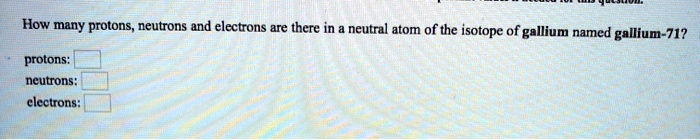
How many protons, neutrons and electrons are there in neutral atom of the isotope of gallium named gallium-71? protons: neutrons: clectrons
The Correct Answer and Explanation is:
Correct Answer:
protons: 31
neutrons: 40
electrons: 31
Explanation:
To determine the number of protons, neutrons, and electrons in an atom of gallium-71, we need to understand the fundamental concepts of atomic structure and isotope notation.
First, let’s identify the number of protons. The number of protons in an atom is defined by its atomic number (Z), which is unique to each element and determines its identity. To find the atomic number for gallium (Ga), we refer to the periodic table. Gallium’s atomic number is 31. Therefore, every atom of gallium, regardless of its isotope, contains exactly 31 protons.
Next, we determine the number of electrons. The problem specifies a “neutral atom.” In a neutral atom, the overall electrical charge is zero. Since protons have a positive charge (+1) and electrons have a negative charge (-1), the number of electrons must equal the number of protons to achieve a neutral state. With 31 positively charged protons, the atom must have 31 negatively charged electrons to balance the charge.
Finally, we find the number of neutrons. The name “gallium-71” provides the mass number (A) of this specific isotope. The mass number represents the total count of protons and neutrons in the atom’s nucleus. The formula to find the number of neutrons is: Number of Neutrons = Mass Number (A) – Atomic Number (Z). For gallium-71, the mass number is 71 and the atomic number is 31.
Using the formula, we calculate the number of neutrons:
Number of Neutrons = 71 – 31 = 40.
In summary, a neutral atom of the isotope gallium-71 has 31 protons, which defines it as gallium; 31 electrons, which makes it electrically neutral; and 40 neutrons, which, when added to the 31 protons, gives it a mass number of 71.