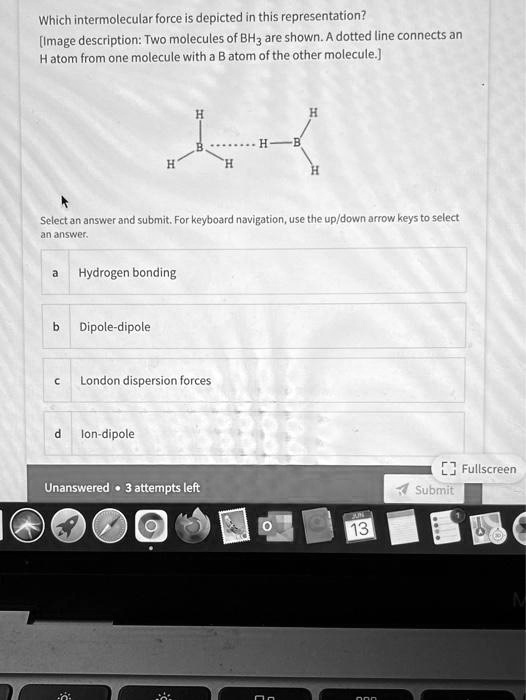
Which intermolecular force is depicted in this representation? (Image description: Two molecules of BH3 are shown. A dotted line connects an H atom from one molecule with an atom of the other molecule.) Select an answer and submit. For keyboard navigation, use the up/down arrow keys to select. A) Hydrogen bonding B) Dipole-dipole C) London dispersion forces D) Ion-dipole Fullscreen Submit Unanswered. 3 attempts left
The Correct Answer and Explanation is:
The correct answer is c) London dispersion forces.
Here is a detailed explanation:
To determine the type of intermolecular force between two borane (BH₃) molecules, we must first analyze the properties of the BH₃ molecule itself, specifically its polarity.
- Bond Polarity: The polarity of a chemical bond depends on the difference in electronegativity between the two atoms. The electronegativity of Boron (B) is approximately 2.04, and for Hydrogen (H), it is about 2.20. The difference is very small (0.16), which means the B-H bond is considered nonpolar.
- Molecular Geometry and Polarity: According to VSEPR theory, the BH₃ molecule has a central boron atom bonded to three hydrogen atoms with no lone pairs on the central atom. This results in a trigonal planar geometry, with the hydrogen atoms arranged symmetrically around the boron atom at 120-degree angles. Even if the bonds had a slight polarity, this symmetrical arrangement would cause the individual bond dipoles to cancel each other out, making the overall molecule nonpolar.
- Evaluating the Intermolecular Forces: Now we can evaluate the given options based on the fact that BH₃ is a nonpolar molecule.
- Ion-dipole forces occur between an ion and a polar molecule. Since BH₃ is a neutral molecule, not an ion, this force is not possible.
- Dipole-dipole forces are attractive forces that exist between polar molecules. Because BH₃ is nonpolar, it does not have a permanent dipole moment, so it cannot experience dipole-dipole forces.
- Hydrogen bonding is a special, strong type of dipole-dipole force that occurs when a hydrogen atom is covalently bonded to a highly electronegative atom (nitrogen, oxygen, or fluorine). In BH₃, hydrogen is bonded to boron, which is not highly electronegative. Therefore, hydrogen bonding cannot occur.
- London dispersion forces (LDFs) are the weakest type of intermolecular force. They are caused by temporary, instantaneous dipoles that arise from the random movement of electrons within a molecule. These temporary dipoles can induce similar dipoles in neighboring molecules, creating a weak attraction. London dispersion forces are present in all atoms and molecules, but they are the only intermolecular force that exists between nonpolar molecules.
Since BH₃ is a nonpolar molecule, the only intermolecular force of attraction between two BH₃ molecules is the London dispersion force. The dotted line in the diagram represents this weak, temporary attraction.