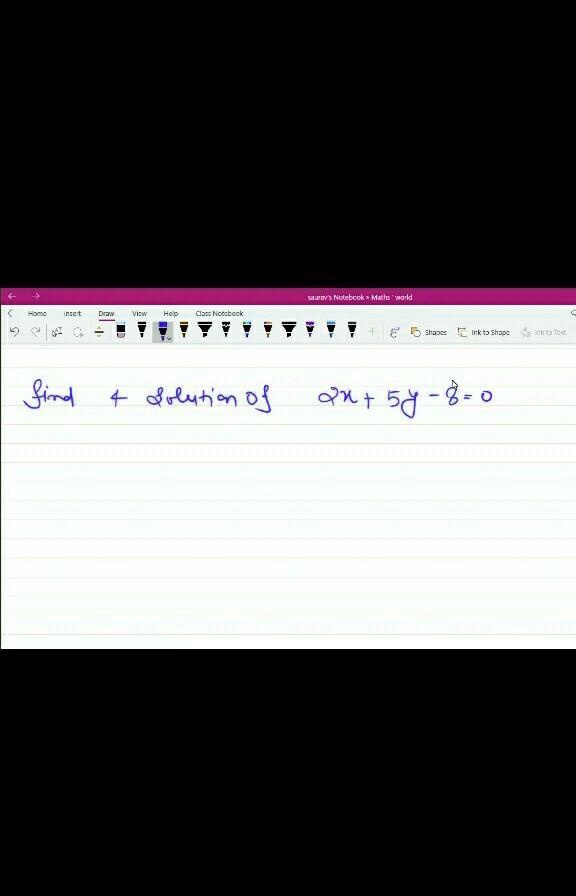
The Correct Answer and Explanation is:
Correct Answer:
Four possible solutions for the equation 2x + 5y – 8 = 0 are:
- (4, 0)
- (-1, 2)
- (3/2, 1)
- (9, -2)
Explanation
The problem asks for four solutions to the linear equation 2x + 5y – 8 = 0. This is an equation with two variables, x and y. A “solution” is an ordered pair of numbers (x, y) that makes the equation true when substituted into it. A linear equation in two variables represents a straight line on a graph, and every point on that line corresponds to a solution. Because a line consists of an infinite number of points, there are infinitely many solutions to this equation. Our task is to find just four of them.
A straightforward method to find solutions is to choose a value for one variable and then solve the equation for the other. To make calculations simpler, it is often helpful to first rearrange the equation to isolate one variable. Let’s isolate y:
2x + 5y – 8 = 0
First, move the terms without y to the other side of the equation:
5y = 8 – 2x
Then, divide by the coefficient of y, which is 5:
y = (8 – 2x) / 5
Now we can easily find solutions by picking any value for x and calculating the corresponding value for y.
Solution 1: Let x = 4
We can choose a simple integer for x. Let’s try x = 4.
y = (8 – 2(4)) / 5
y = (8 – 8) / 5
y = 0 / 5
y = 0
So, our first solution is the ordered pair (4, 0).
Solution 2: Let x = -1
Let’s pick another integer for x, for instance, x = -1.
y = (8 – 2(-1)) / 5
y = (8 + 2) / 5
y = 10 / 5
y = 2
This gives us our second solution, (-1, 2).
Solution 3: Let y = 1
We can also choose a value for y and solve for x. Let’s use the original equation for this. Let y = 1.
2x + 5(1) – 8 = 0
2x + 5 – 8 = 0
2x – 3 = 0
2x = 3
x = 3/2
This solution involves a fraction, which is perfectly valid. Our third solution is (3/2, 1).
Solution 4: Let y = -2
Let’s find another solution by choosing a different value for y, for example, y = -2.
2x + 5(-2) – 8 = 0
2x – 10 – 8 = 0
2x – 18 = 0
2x = 18
x = 9
Our fourth solution is (9, -2).
We can verify any of these solutions by plugging them back into the original equation. For example, using (-1, 2): 2(-1) + 5(2) – 8 = -2 + 10 – 8 = 0. Since the equation holds true, the solution is correct. This process can be repeated with any chosen number for x or y to generate an unlimited number of other valid solutions