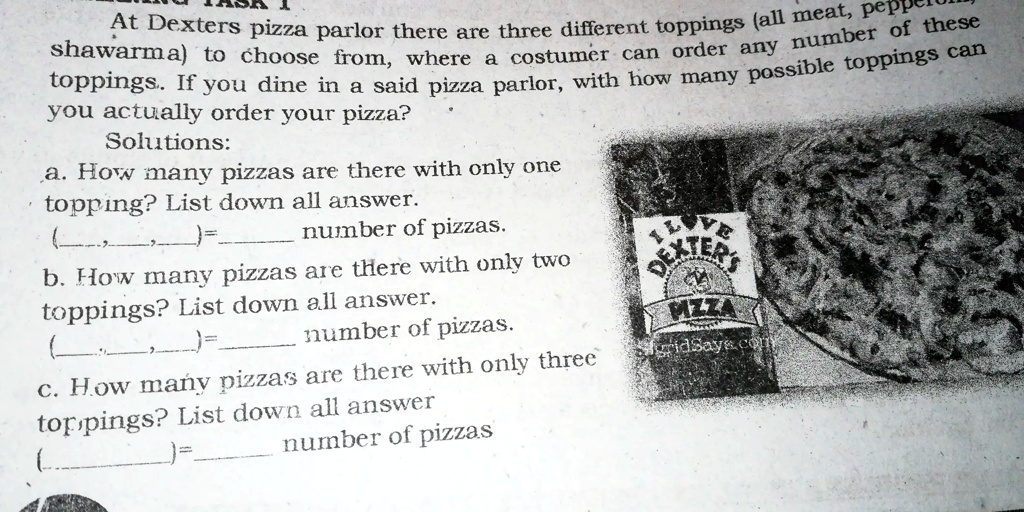
At Dexters pizza parlor there are three different toppings (all meat, pepperonishawwarma) to choose from, where a costumer can order any number of thesetoppings. If you dine in a said pizza parlor, with how many possible toppings canyou actually order your pizza? Solutions: a. How many pizzas are there with only onetopping? List down all answer. (, , ) = _ number of pizzas. b. How many pizzas are there with only twotoppings? List down all answer. (, , ) = _ number of pizzas. c. How many pizzas are there with only threetoppings? List down all answer (, , ) = __ number of pizzas
The Correct Answer and Explanation is:
Of course! Here are the correct answers to the questions based on the image provided, along with a detailed explanation.
Solutions
a. How many pizzas are there with only one topping? List down all answer.
(All Meat, Pepperoni, Shawarma) = 3 number of pizzas.
b. How many pizzas are there with only two toppings? List down all answer.
(All Meat & Pepperoni, All Meat & Shawarma, Pepperoni & Shawarma) = 3 number of pizzas.
c. How many pizzas are there with only three toppings? List down all answer.
(All Meat, Pepperoni & Shawarma) = 1 number of pizzas.
Explanation
This problem is a classic exercise in combinatorics, a branch of mathematics focused on counting combinations and arrangements of objects. The key is to determine how many different groups of toppings can be made from the three available options: All Meat, Pepperoni, and Shawarma. Since the order in which toppings are added to a pizza doesn’t matter (a pepperoni and shawarma pizza is the same as a shawarma and pepperoni pizza), we are dealing with combinations, not permutations.
a. Pizzas with one topping:
To find the number of pizzas with a single topping, we simply need to count how many individual toppings are available to choose from. The options are All Meat, Pepperoni, or Shawarma. Since there are three distinct choices, there are three possible pizzas with only one topping. In mathematical terms, this is a combination of choosing 1 item from a set of 3, often written as C(3,1), which equals 3.
b. Pizzas with two toppings:
For pizzas with two toppings, we must find all the unique pairs we can form from the three options. We can list them systematically to avoid repetition:
- All Meat and Pepperoni
- All Meat and Shawarma
- Pepperoni and Shawarma
There are no other unique pairs. For example, selecting “Pepperoni and All Meat” is the same combination as the first pair listed. This calculation, C(3,2), also results in 3 unique combinations.
c. Pizzas with three toppings:
To find the number of pizzas with all three toppings, we must select all the options available. Since there are only three toppings in total (All Meat, Pepperoni, and Shawarma), there is only one way to create a pizza that includes every single one. This is a combination of choosing 3 items from a set of 3, or C(3,3), which always equals 1