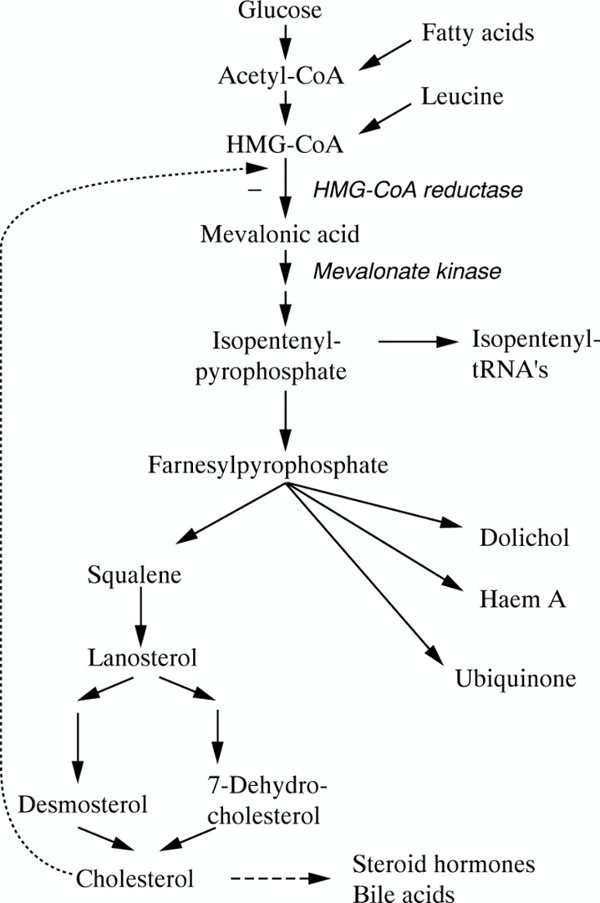
Glucose Fatty acids Acetyl-CoA Leucine HMG-CoA HMG-CoA reductase Mevalonic acid Mevalonate kinase Isopentenyl pyrophosphate Isopentenyl tRNA’s Farnesylpyrophosphate Dolichol Squalene Haem A Lanosterol Ubiquinone 7-Dehydrocholesterol Desmosterol Steroid hormones Bile acids Cholesterol
The Correct Answer and Explanation is:
Correct Answer
Glucose, Fatty acids, Acetyl-CoA, Leucine, HMG-CoA, HMG-CoA reductase, Mevalonic acid, Mevalonate kinase, Isopentenyl pyrophosphate, Isopentenyl tRNA’s, Farnesylpyrophosphate, Dolichol, Squalene, Haem A, Lanosterol, Ubiquinone, Desmosterol, 7-Dehydrocholesterol, Cholesterol, Steroid hormones, Bile acids.
Explanation
The provided image illustrates the mevalonate pathway, a critical metabolic route responsible for the synthesis of cholesterol and other essential isoprenoid compounds in animal cells. The pathway begins with the two-carbon molecule Acetyl-CoA, which serves as the primary building block. Acetyl-CoA can be derived from multiple sources, including the breakdown of glucose through glycolysis, the oxidation of fatty acids, or the catabolism of certain amino acids like leucine.
Multiple Acetyl-CoA units condense to form HMG-CoA (3-hydroxy-3-methylglutaryl-CoA). The subsequent conversion of HMG-CoA to mevalonic acid is a pivotal and tightly regulated step. This reaction is catalyzed by the enzyme HMG-CoA reductase and is the rate-limiting step of the entire pathway. The diagram shows a negative feedback loop, indicated by the dotted line from cholesterol, signifying that high levels of cholesterol inhibit the activity of HMG-CoA reductase, thus self-regulating its own production. This enzyme is the primary target for statin drugs, which are widely used to lower cholesterol levels.
Mevalonic acid is then converted through several steps, involving the enzyme mevalonate kinase, into isopentenyl pyrophosphate (IPP). IPP is a fundamental five-carbon isoprenoid unit. It can be used for synthesizing other molecules like isopentenyl-tRNAs. Successive condensations of IPP units lead to the formation of farnesyl pyrophosphate (FPP).
FPP represents a major branch point in the pathway. While some FPP is directed towards cholesterol synthesis by forming squalene, a significant portion is diverted to produce other vital non-sterol compounds. As shown in the diagram, these include dolichol (involved in glycoprotein synthesis), haem A (a component of cytochrome c oxidase in the electron transport chain), and ubiquinone (Coenzyme Q10), another crucial electron carrier.
The main pathway continues with squalene cyclizing to form lanosterol, the first sterol intermediate. Lanosterol then undergoes a complex series of enzymatic modifications, proceeding through intermediates like desmosterol or 7-dehydrocholesterol, to finally yield cholesterol. Cholesterol itself is not just an end product; it is a vital component of cell membranes and serves as the precursor for the synthesis of all steroid hormones and bile acids