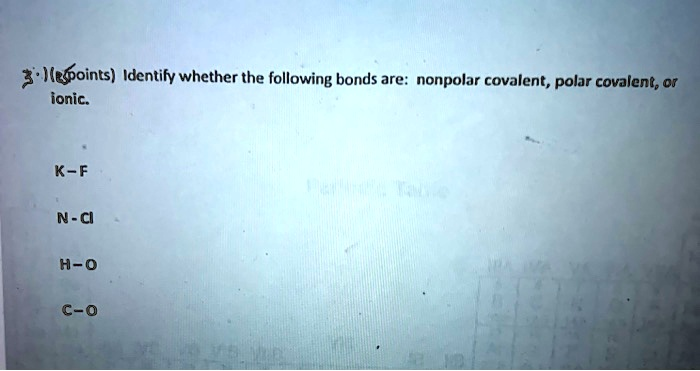
Identify whether the following bonds are: nonpolar covalent; polar covalent; or ionic: K-F N-C H-O C-O
The Correct Answer and Explanation is:
Here are the classifications for each bond:
- K-F: Ionic
- N-Cl: Nonpolar Covalent
- H-O: Polar Covalent
- C-O: Polar Covalent
The type of chemical bond between two atoms is determined by the difference in their electronegativity (ΔEN), which is the measure of an atom’s ability to attract electrons in a bond. The greater the difference, the more ionic the bond becomes.
A general guideline for classifying bonds is as follows:
- A ΔEN of less than 0.4 results in a nonpolar covalent bond, where electrons are shared equally.
- A ΔEN between 0.4 and 1.8 indicates a polar covalent bond, where electrons are shared unequally.
- A ΔEN greater than 1.8 typically signifies an ionic bond, where electrons are transferred from one atom to another.
Applying these principles to the given pairs:
K-F: Potassium (K) is a metal with a very low electronegativity (EN ≈ 0.82), while fluorine (F) is a nonmetal with the highest electronegativity of any element (EN ≈ 3.98). The difference, ΔEN, is approximately 3.16. This value is very large and well above the 1.8 threshold, indicating a complete transfer of an electron from potassium to fluorine. This creates a K+ ion and an F- ion, which are held together by electrostatic attraction, forming an ionic bond.
N-Cl: Nitrogen (N) and chlorine (Cl) are both nonmetals. Their electronegativity values are surprisingly similar. Nitrogen has an EN of about 3.04, and chlorine has an EN of about 3.16. The difference is a very small 0.12. Since this ΔEN is less than 0.4, the electrons are shared almost equally between the two atoms, resulting in a nonpolar covalent bond.
H-O: Hydrogen (H) has an EN of about 2.20, and oxygen (O) has a much higher EN of about 3.44. The difference is 1.24. This value falls squarely in the polar covalent range. The highly electronegative oxygen atom pulls the shared electrons closer to its nucleus, creating a partial negative charge on the oxygen and a partial positive charge on the hydrogen.
C-O: Carbon (C) has an EN of about 2.55, and oxygen (O) has an EN of 3.44. The difference is 0.89. This difference is significant enough to cause unequal sharing of the bonding electrons. Therefore, the C-O bond is classified as polar covalent, with oxygen being the more electronegative atom and carrying a partial negative charge.thumb_upthumb_down