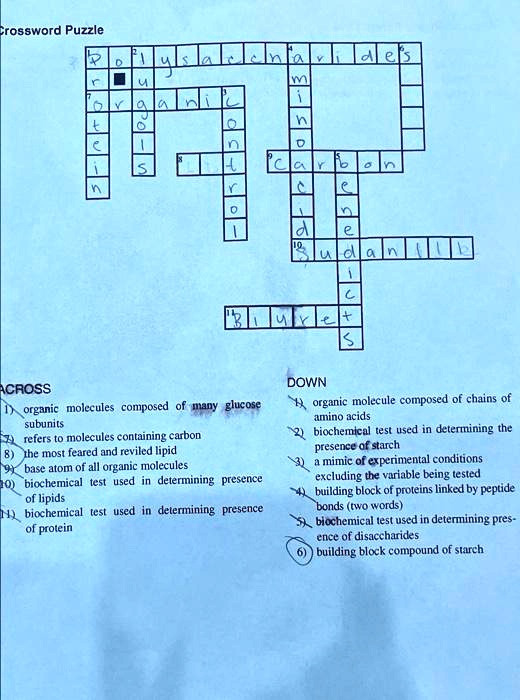
Crossword Puzzle ACROSS 1) organic molecules composed of many glucose subunits 2) refers to molecules containing carbon 8) the most feared and reviled lipid 9) base atom of all organic molecules 10) biochemical test used in determining presence of lipids 11) biochemical test used in determining presence of protein DOWN 1) organic molecule composed of chains of amino acids 2) biochemical test used in determining the presence of starch 3) a mimic of experimental conditions excluding the variable being tested 4) building block of proteins linked by peptide bonds (two words) 5) biochemical test used in determining pres- ence of disaccharides 6) building block compound of starch
The Correct Answer and Explanation is:
The correct answer for clue 6 DOWN, “building block compound of starch,” is GLUCOSE.
In the field of biochemistry, large biological molecules, which are often called macromolecules or polymers, are assembled from smaller, repeating chemical units known as monomers. The clue’s phrase “building block compound” is a clear way of asking for the specific monomer that makes up the polymer in question, which is starch.
Starch is a familiar complex carbohydrate, scientifically classified as a polysaccharide. It serves as the main form of energy storage in plants and is a foundational component of the human diet, found in staple foods like potatoes, corn, rice, and wheat. A single starch molecule is a massive polymer that can consist of thousands of smaller units chemically bonded together into long chains.
The fundamental building block, or monomer, that constructs these extensive starch chains is glucose. Glucose is a simple sugar, or a monosaccharide, with the chemical formula C6H12O6. It is a vital source of energy for nearly all living organisms, acting as the primary fuel for cellular respiration. Plants produce glucose through photosynthesis and then, to store this energy for later use, they link numerous glucose molecules together to create starch. The chemical bonds that join the glucose units are known as glycosidic linkages.
Starch typically exists in two main forms: amylose and amylopectin. Amylose is composed of long, linear chains of glucose, while amylopectin is a highly branched polymer. Despite their different structures, the exclusive component for both is glucose. When humans or other animals eat starchy foods, their digestive systems produce enzymes, such as amylase, that break down the large starch polymers back into their individual glucose monomers. This free glucose is then absorbed into the bloodstream and transported to cells throughout the body, where it provides the necessary energy for all metabolic functions. Thus, glucose is the essential building block of starch.