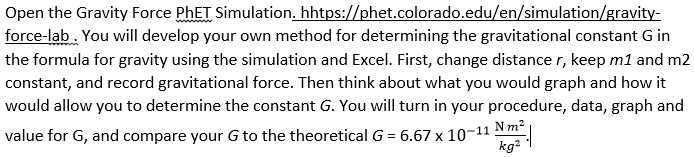
Open the Gravity Force PhET Simulation.
The Correct Answer and Explanation is:
To determine the gravitational constant G using the PhET simulation, you must linearize the data by plotting the gravitational force (F) as a function of the inverse square of the distance (1/r²). The slope of this linear graph can then be used to calculate G.
Explanation
The goal of this experiment is to find the value of the universal gravitational constant, G, from the formula F = G * (m1 * m2) / r². A simple graph of the force (F) versus the distance (r) would produce a curve, which is not ideal for finding a constant value directly. To solve this, we can rearrange the equation to fit the form of a straight line, y = mx + b.
By treating the force F as our y variable and 1/r² as our x variable, the equation becomes F = (G * m1 * m2) * (1/r²). This equation now matches the linear format y = mx. In this case, the y-value is the force F, the x-value is 1/r², and the slope (m) of the line is the entire term in the parenthesis, which is G * m1 * m2. The y-intercept (b) is zero.
The correct procedure is as follows. First, in the simulation, set the masses m1 and m2 to fixed, known values. Then, record at least five different values for the distance (r) and the corresponding gravitational force (F).
In a spreadsheet program, create three columns: one for distance (r), one for force (F), and a third calculated column for 1/r². Next, create a scatter plot with Force (F) on the vertical y-axis and 1/r² on the horizontal x-axis. The resulting data points should form a straight line. Add a linear trendline to your graph, and use the software to display the equation of the line. The slope of this line is equal to G * m1 * m2.
Finally, to calculate your experimental value for G, you simply divide the slope from your graph by the product of the two masses you used: G = slope / (m1 * m2).thumb_upthumb_down