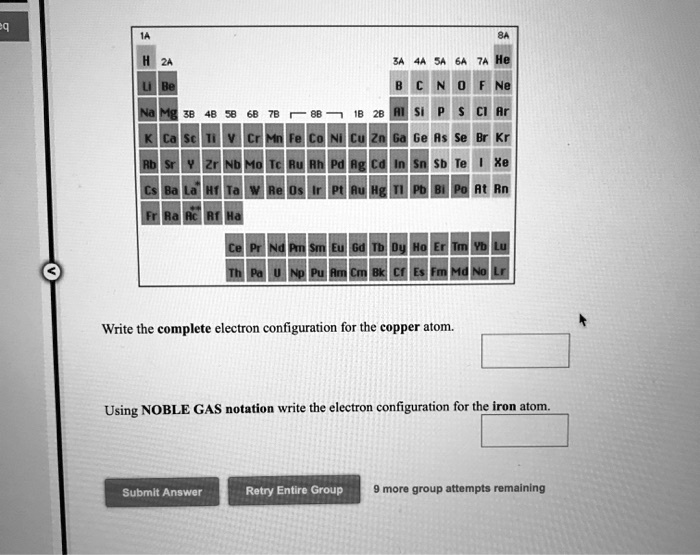
1A H 2A Li Be 8A 3A 4A 5A 6A 7A He BCNO F Ne Na Mg 38 48 58 68 78 88 1B 2B AI Si P S Cl Ar K Ca Sc Ti V Cr Mn Fe Co Ni Cu Zn Ga Ge As Se Br Kr Rb Sr Y Zr Nb Mo Tc Ru Rh Pd Ag Cd In Sn Sb Te I Xe Cs Ba La Hf Ta W Re Os Ir Pt Au Hg Tl Pb Bi Po At Rn Fr Ra Ac Rf Ha Ce Pr Nd Pm Sm Eu Gd Tb Dy Ho Er Tm Yb Lu Th Pa U Np Pu Am Cm Bk Cf Es Fm Md No Lr Write the complete electron configuration for the copper atom. Using NOBLE GAS notation write the electron configuration for the iron atom. Submit Answer Retry Entire Group 9 more group attempts remaining
The Correct Answer and Explanation is:
Here are the correct answers and a detailed explanation for each question.
Answer 1 (Copper): 1s²2s²2p⁶3s²3p⁶4s¹3d¹⁰
Answer 2 (Iron): [Ar] 4s²3d⁶
Explanation
Electron configuration describes how electrons are distributed among the various atomic orbitals within an atom. There are two common ways to write this: the complete configuration and the shorthand noble gas notation.
1. Complete Electron Configuration for Copper (Cu)
First, locate copper (Cu) on the periodic table. It is in period 4 and has an atomic number of 29, which means a neutral copper atom has 29 electrons. We fill the orbitals in order of increasing energy, following the Aufbau principle.
The standard order of filling is: 1s, 2s, 2p, 3s, 3p, 4s, 3d, and so on.
Following this, one would expect the configuration to be:
1s²2s²2p⁶3s²3p⁶4s²3d⁹
However, copper is a well-known exception to this rule. Atoms gain extra stability when their d-subshells are either half-filled (d⁵) or completely filled (d¹⁰). In the expected configuration, the 3d subshell is one electron away from being full (3d⁹). To achieve the more stable state of a completely filled 3d subshell, one electron from the 4s orbital is promoted to the 3d orbital.
This changes the configuration from 4s²3d⁹ to 4s¹3d¹⁰. Therefore, the correct and more stable ground-state electron configuration for copper is 1s²2s²2p⁶3s²3p⁶4s¹3d¹⁰.
2. Noble Gas Notation for Iron (Fe)
Noble gas notation is a shorthand method that simplifies writing electron configurations for larger atoms. First, locate iron (Fe) on the periodic table. It is in period 4 with an atomic number of 26, meaning it has 26 electrons.
To use noble gas notation, we find the noble gas from the period before the element. For iron (in period 4), the preceding noble gas is Argon (Ar, in period 3). Argon has an atomic number of 18, and its configuration (1s²2s²2p⁶3s²3p⁶) represents the first 18 electrons of iron. We write this core as [Ar].
Next, we account for the remaining electrons (26 total electrons – 18 core electrons = 8 remaining electrons). We place these 8 electrons into the orbitals of the next period (period 4). The 4s orbital is filled first with 2 electrons (4s²). The remaining 6 electrons then go into the 3d orbital (3d⁶).
Combining the noble gas core with the valence electrons gives the final configuration for iron: [Ar] 4s²3d⁶.