
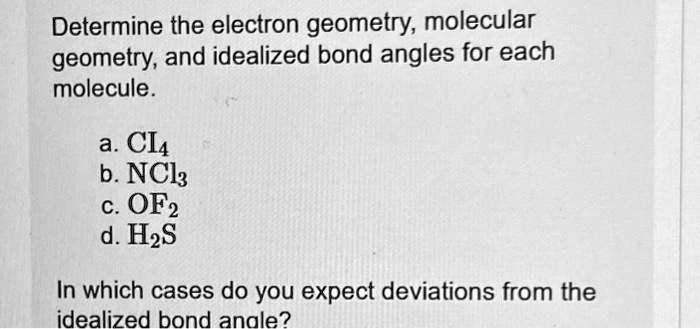
Determine the electron geometry, molecular geometry, and idealized bond angles for each molecule. a. CI4 b. NCl3 c. OF2 d. H2S In which cases do you expect deviations from the idealized bond angle?
The Correct Answer and Explanation is:
Here is the determination of the geometries and bond angles for each molecule.
a. CI₄ (Carbon Tetraiodide)
- Electron Geometry: Tetrahedral
- Molecular Geometry: Tetrahedral
- Idealized Bond Angle: 109.5°
b. NCl₃ (Nitrogen Trichloride)
- Electron Geometry: Tetrahedral
- Molecular Geometry: Trigonal Pyramidal
- Idealized Bond Angle: 109.5°
c. OF₂ (Oxygen Difluoride)
- Electron Geometry: Tetrahedral
- Molecular Geometry: Bent
- Idealized Bond Angle: 109.5°
d. H₂S (Hydrogen Sulfide)
- Electron Geometry: Tetrahedral
- Molecular Geometry: Bent
- Idealized Bond Angle: 109.5°
Cases with Expected Deviations from Idealized Bond Angles:
Deviations are expected in NCl₃, OF₂, and H₂S.
Explanation
This analysis is based on the Valence Shell Electron Pair Repulsion (VSEPR) theory, which states that electron domains around a central atom will arrange themselves to be as far apart as possible to minimize repulsion. An electron domain can be a lone pair or a chemical bond.
For CI₄, the central carbon atom forms four single bonds with four iodine atoms. This creates four bonding electron domains and zero lone pairs. With four total domains, the electron geometry is tetrahedral. Since all domains are bonding pairs, the molecular geometry is also tetrahedral. The idealized angle for this perfect symmetry is 109.5°, and no deviation is expected.
For NCl₃, the central nitrogen atom has five valence electrons. It forms three single bonds with chlorine atoms and has one lone pair. This results in four total electron domains (three bonding, one lone pair). The arrangement of these four domains is a tetrahedral electron geometry. However, because the lone pair is not part of the molecular shape, the arrangement of the atoms is trigonal pyramidal. The idealized angle is 109.5°, but the lone pair exerts a stronger repulsive force than bonding pairs, compressing the Cl-N-Cl bond angle to be less than 109.5°.
For OF₂, the central oxygen atom has six valence electrons. It forms two single bonds with fluorine atoms and has two lone pairs. This again gives four total electron domains (two bonding, two lone pairs), resulting in a tetrahedral electron geometry. With two lone pairs, the molecular geometry is bent. The two lone pairs create significant repulsion, pushing the O-F bonds closer together. This causes the F-O-F bond angle to be significantly less than the idealized 109.5°.
For H₂S, the central sulfur atom is similar to oxygen. It has six valence electrons, forming two bonds with hydrogen and leaving two lone pairs. This creates four electron domains (two bonding, two lone pairs), so the electron geometry is tetrahedral and the molecular geometry is bent. Like with OF₂, the two lone pairs on the sulfur atom will compress the H-S-H bond angle, causing it to deviate and be smaller than 109.5

°.