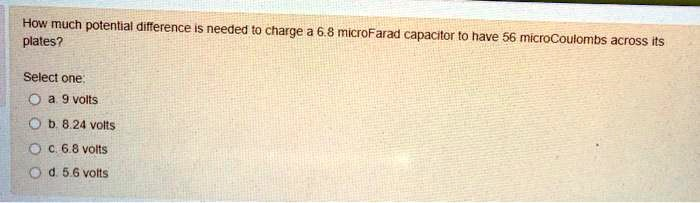
How much potential difference is needed to charge a 6.8 microFarad capacitor to have 56 microCoulombs across its plates? Select one: a. 9 volts b. 8.24 volts c. 6.8 volts d. 5.6 volts
The Correct Answer and Explanation is:
To determine the potential difference (voltage) needed to charge the capacitor, we can use the formula for capacitance:Q=C×VQ = C \times VQ=C×V
Where:
- QQQ is the charge in coulombs,
- CCC is the capacitance in farads,
- VVV is the potential difference (voltage) in volts.
In this problem:
- The charge Q=56 μC=56×10−6 CQ = 56 \, \mu C = 56 \times 10^{-6} \, CQ=56μC=56×10−6C,
- The capacitance C=6.8 μF=6.8×10⁻⁶ FC = 6.8 \, \mu F = 6.8 \times 10^{-6} \, FC=6.8μF=6.8×10⁻⁶F.
We need to find the voltage VVV, so rearranging the formula:V=QCV = \frac{Q}{C}V=CQ
Substitute the known values:V=56×10−66.8×10−6=566.8=8.24 volts.V = \frac{56 \times 10^{-6}}{6.8 \times 10^{-6}} = \frac{56}{6.8} = 8.24 \, \text{volts}.V=6.8×10−656×10−6=6.856=8.24volts.
Thus, the correct answer is b. 8.24 volts.
This result is derived from the relationship between charge, capacitance, and voltage. Since the capacitance is constant, a larger charge requires a higher potential difference, and this equation directly gives us the necessary voltage to achieve the specified charge on the capacitor.