Course Messages Forums Calendar Gradebook Log Out Home
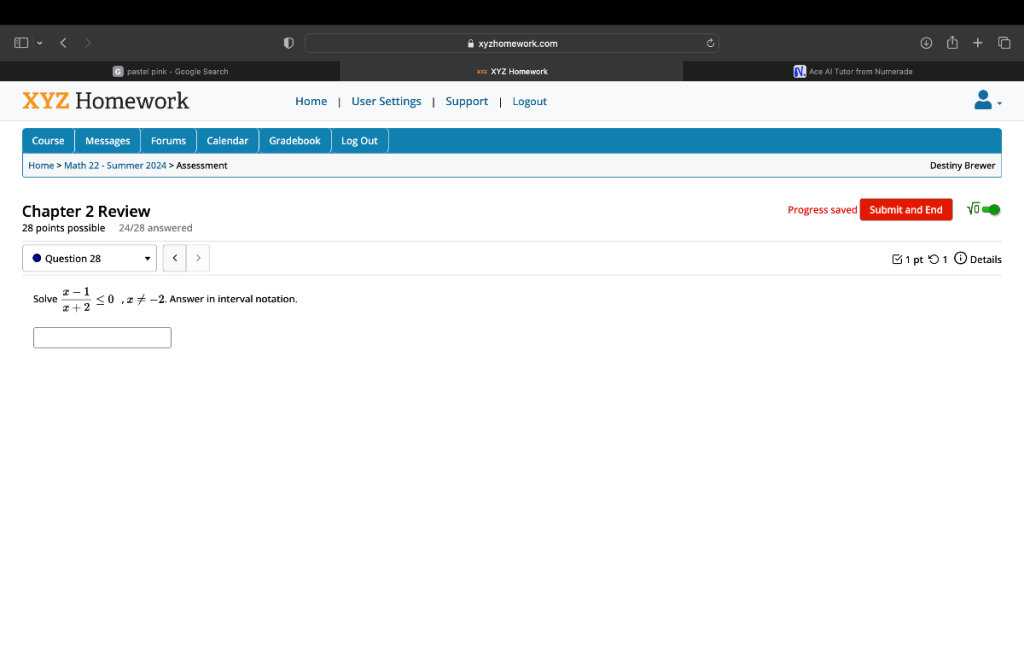
The Correct Answer and Explanation is:
(-2, 1]
Explanation:
To solve the rational inequality (x – 1) / (x + 2) ≤ 0, we need to find the values of x for which the expression is negative or equal to zero. The process involves identifying critical points and testing the intervals they create on the number line.
First, we find the critical points by setting both the numerator and the denominator equal to zero. These are the points where the expression can change its sign from positive to negative or vice versa.
- Set the numerator to zero:
x – 1 = 0
x = 1
At x = 1, the entire expression equals zero, which satisfies the “or equal to” part of the inequality. - Set the denominator to zero:
x + 2 = 0
x = -2
At x = -2, the expression is undefined because division by zero is not allowed. This point must be excluded from the final solution.
These two critical points, -2 and 1, divide the number line into three distinct intervals: (-∞, -2), (-2, 1), and (1, ∞). We test a value from each interval to determine if the expression is positive or negative in that region.
- Interval 1: (-∞, -2)
Let’s test x = -3.
((-3) – 1) / ((-3) + 2) = -4 / -1 = 4. The result is positive, so this interval is not part of the solution. - Interval 2: (-2, 1)
Let’s test x = 0.
(0 – 1) / (0 + 2) = -1 / 2. The result is negative, which satisfies the inequality. This interval is part of the solution. - Interval 3: (1, ∞)
Let’s test x = 2.
(2 – 1) / (2 + 2) = 1 / 4. The result is positive, so this interval is not part of the solution.
Finally, we combine our findings. The solution lies in the interval (-2, 1). We must include the endpoint x = 1 because the inequality allows for the expression to be equal to zero. We must exclude the endpoint x = -2 because it makes the denominator zero. In interval notation, we of x for which the expression is negative or equal to zero. The first step is to identify the critical points, which are the values that make the numerator or the denominator equal to zero.
The numerator, x – 1, is zero when x = 1.
The denominator, x + 2, is zero when x = -2.
These critical points, -2 and 1, divide the number line into three intervals: (-∞, -2), (-2, 1), and (1, ∞). We will test a point from each interval to determine if the expression is positive or negative in that region.
For the interval (-∞, -2), let’s test x = -3.
((-3) – 1) / ((-3) + 2) = (-4) / (-1) = 4. This is a positive value, so this interval is not part of the solution.
For the interval (-2, 1), let’s test x = 0.
((0) – 1) / ((0) + 2) = -1 / 2. This is a negative value, which satisfies the “less than zero” condition of the inequality. Therefore, this interval is part of the solution.
For the interval (1, ∞), let’s test x = 2.
((2) – 1) / ((2) + 2) = 1 / 4. This is a positive value, so this interval is not part of the solution.
Finally, we examine the critical points themselves. The inequality includes “or equal to” zero (≤), so we include the value where the expression equals zero. This happens when the numerator is zero, at x = 1. Thus, 1 is included in the solution. The value x = -2 makes the denominator zero, causing the expression to be undefined. The problem also explicitly states x ≠ -2, so -2 must be excluded.
Combining our results, the solution set includes the interval from -2 to 1. We exclude -2 and include 1. In interval notation, this is written as (-2, 1]. use a square bracket ] to include an endpoint and a parenthesis ( to exclude it. Thus, the final answer is (-2, 1].