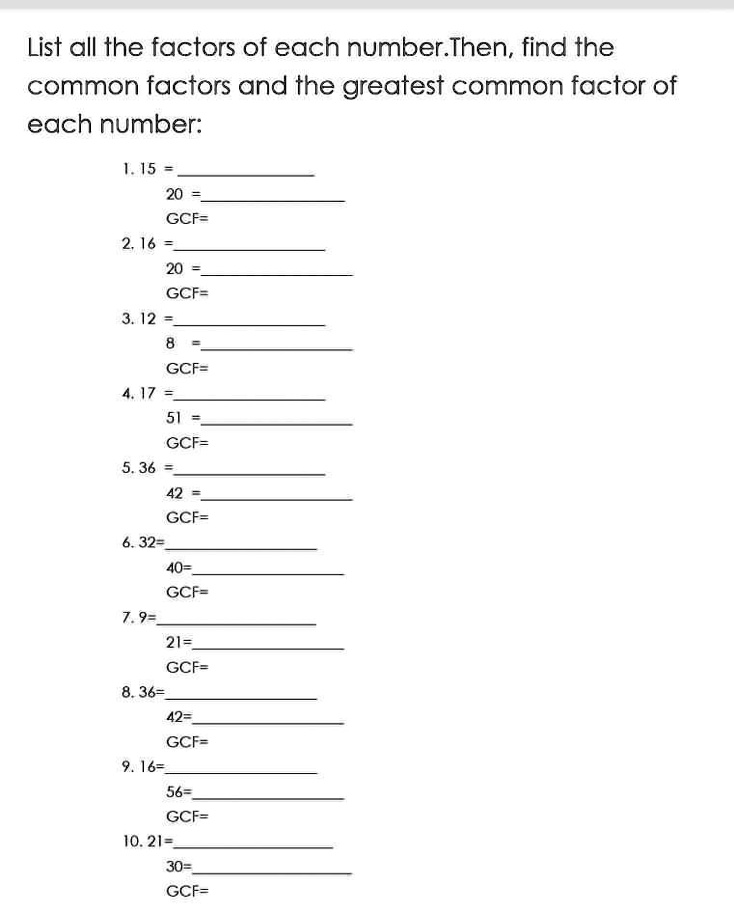
List all the factors of each number. Then, find the common factors and the greatest common factor of each number: 1. 15 = 20 = GCF= 2. 16 = 20 = GCF= 3. 12 8 GCF= 4. 17 = 51 = GCF= 5. 36 = 42 = GCF= 6. 32= 40= GCF= 7. 9= 21= GCF= 8. 36= 42= GCF= 9. 16= 56= GCF= 10. 21= 30= GCF=
The Correct Answer and Explanation is:
Of course. Here are the completed answers for the worksheet, followed by an explanation of the process.
1. 15 = 1, 3, 5, 15
20 = 1, 2, 4, 5, 10, 20
GCF= 5
2. 16 = 1, 2, 4, 8, 16
20 = 1, 2, 4, 5, 10, 20
GCF= 4
3. 12 = 1, 2, 3, 4, 6, 12
8 = 1, 2, 4, 8
GCF= 4
4. 17 = 1, 17
51 = 1, 3, 17, 51
GCF= 17
5. 36 = 1, 2, 3, 4, 6, 9, 12, 18, 36
42 = 1, 2, 3, 6, 7, 14, 21, 42
GCF= 6
6. 32= 1, 2, 4, 8, 16, 32
40= 1, 2, 4, 5, 8, 10, 20, 40
GCF= 8
7. 9= 1, 3, 9
21= 1, 3, 7, 21
GCF= 3
8. 36= 1, 2, 3, 4, 6, 9, 12, 18, 36
42= 1, 2, 3, 6, 7, 14, 21, 42
GCF= 6
9. 16= 1, 2, 4, 8, 16
56= 1, 2, 4, 7, 8, 14, 28, 56
GCF= 8
10. 21= 1, 3, 7, 21
30= 1, 2, 3, 5, 6, 10, 15, 30
GCF= 3
Explanation of the Method
This worksheet focuses on finding factors, common factors, and the Greatest Common Factor (GCF) for pairs of numbers. A factor is a whole number that divides another number exactly, leaving no remainder. The process begins by systematically listing all the factors for each number in a given pair.
To find the factors of a number, like 15, we look for all the numbers that can be multiplied to get 15. We always start with 1, as 1 times the number itself (1 x 15) is always a factor pair. Then we check 2 (no), then 3 (yes, 3 x 5). Since 5 is the next number to check and we already have it, we have found all the factors: 1, 3, 5, and 15. Similarly, for the number 20, the factors are 1, 2, 4, 5, 10, and 20.
Once the factors for both numbers are listed, we identify the “common factors”. These are the numbers that appear in both lists. For 15 and 20, the common factors are 1 and 5.
The final step is to determine the “Greatest Common Factor,” or GCF. This is simply the largest number among the common factors. In our example with 15 and 20, the GCF is 5.
This same method is applied to every problem on the sheet. For instance, with 32 and 40 (problem 6), the factors of 32 are 1, 2, 4, 8, 16, 32, and the factors of 40 are 1, 2, 4, 5, 8, 10, 20, 40. The common factors are 1, 2, 4, and 8. The largest of these is 8, making 8 the GCF. This fundamental concept of finding the GCF is crucial in mathematics, especially when simplifying fractions and solving algebraic problems.thumb_upthumb_down