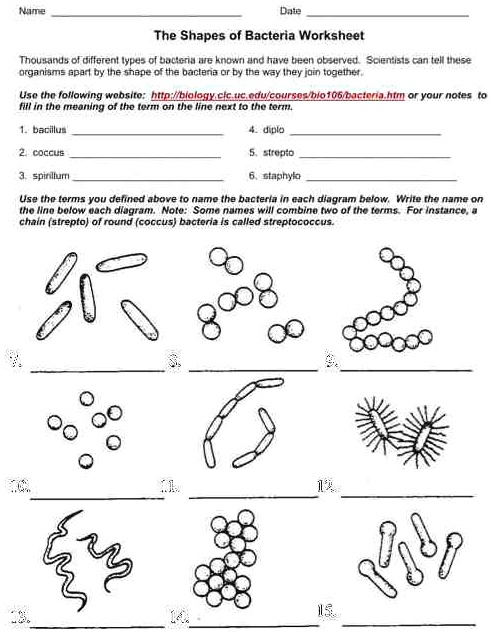
Name Date The Shapes of Bacteria Worksheet Thousands of different types of bacteria are known and have been observed. Scientists can tell these organisms apart by the shape of the bacteria or by the way they join together. Use the following website: http://biology.cic.uc.edu/courses/bio106/bacteria.htm or your notes to fill in the meaning of the term on the line next to the term. 1. bacillus 2. coccus 3. spirillum 4. diplo 5. strepto 6. staphylo Use the terms you defined above to name the bacteria in each diagram below. Write the name on the line below each diagram. Note: Some names will combine two of the terms. For instance, a chain (strepto) of round (coccus) bacteria is called streptococcus.
The Correct Answer and Explanation is:
Of course. Here are the correct answers for the worksheet and a detailed explanation.
Worksheet Answers
Definitions:
- bacillus: Rod-shaped bacterium
- coccus: Spherical or round-shaped bacterium
- spirillum: Spiral or corkscrew-shaped bacterium
- diplo: Paired arrangement
- strepto: Chain-like arrangement
- staphylo: Grape-like cluster arrangement
Diagram Identification:
7. Bacillus
8. Diplococcus
9. Streptococcus
10. Coccus
11. Streptobacillus
12. Bacillus
13. Spirillum
14. Staphylococcus
15. Bacillus
Explanation
Bacteria are classified based on their morphology, which includes both their individual shape and their arrangement after cell division. This worksheet covers the most fundamental terms used in this classification system.
There are three primary shapes of bacteria. Coccus (plural: cocci) refers to bacteria that are spherical or round. Bacillus (plural: bacilli) describes bacteria that are rod-shaped. The third shape, spirillum (plural: spirilla), refers to bacteria with a spiral or corkscrew form, as seen in diagram 13.
In addition to shape, bacteria are named by how they group together. The prefix diplo indicates that the bacteria are arranged in pairs, a result of dividing in one plane and remaining attached. For example, diagram 8 shows pairs of round cells, which are called diplococcus. The prefix strepto describes bacteria that form chains, which occurs when cells divide repeatedly in one plane without separating. Diagram 9 illustrates streptococcus (chains of spheres), and diagram 11 shows streptobacillus (chains of rods). The prefix staphylo is used for bacteria that form irregular, grape-like clusters. This arrangement results from cell division in multiple planes. Diagram 14, showing clusters of round cells, is named staphylococcus.
Some bacteria do not form specific arrangements and exist as individual cells. This is shown in diagram 10 (coccus) and diagram 7 (bacillus). Diagrams 12 and 15 also depict types of bacilli. Diagram 12 shows bacilli with flagella, which are structures for movement but do not change the shape name. Diagram 15 shows a specific club-shaped bacillus. By combining these shape and arrangement terms, scientists can accurately and descriptively name different types of bacteria