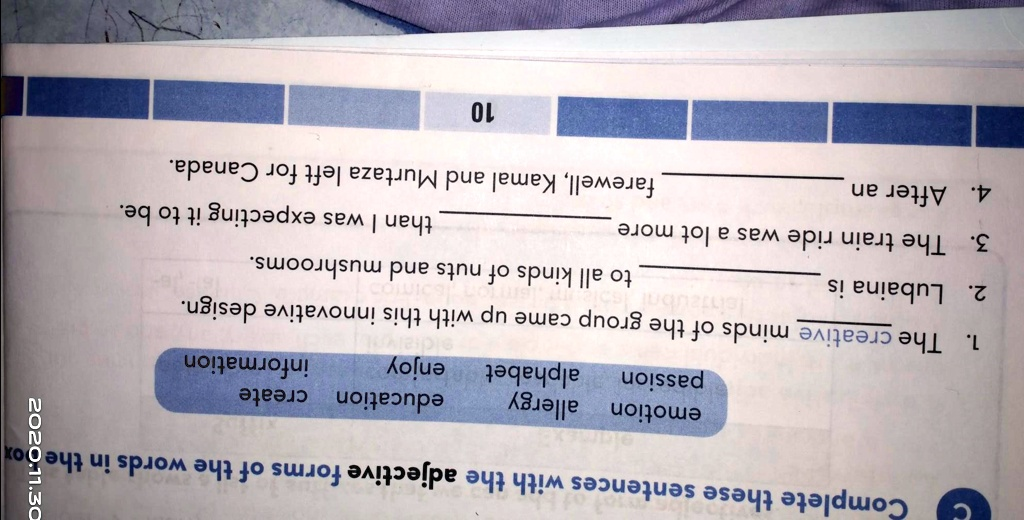
Complete these sentences with the adjective forms of the words in the box: emotion, allergy, education, create, passion, alphabet, enjoy, information. 1. The creative minds of the group came up with this innovative design. 2. Lubaina is allergic to all kinds of nuts and mushrooms. 3. The train ride was a lot more enjoyable than I was expecting it to be. 4. After an emotional farewell, Kamal and Murtaza left for Canada
The Correct Answer and Explanation is:
Based on the information in the image and the words provided in the box, here are the correct adjective forms that complete the sentences:
- The creative minds of the group came up with this innovative design.
- The adjective “creative” is derived from the noun “create.” It describes the minds of the group, emphasizing their ability to come up with something innovative.
- Lubaina is allergic to all kinds of nuts and mushrooms.
- The adjective “allergic” comes from the noun “allergy” and is used to describe Lubaina’s reaction to certain foods.
- The train ride was a lot more enjoyable than I was expecting it to be.
- The adjective “enjoyable” comes from the verb “enjoy” and describes the train ride as being pleasant.
- After an emotional farewell, Kamal and Murtaza left for Canada.
- The adjective “emotional” is derived from the noun “emotion” and emphasizes the feelings experienced during the farewell.
Explanation:
The process of turning nouns or verbs into adjectives is a common way to add detail and meaning to a sentence. In this case, the words provided in the box (emotion, allergy, education, create, passion, alphabet, enjoy, information) are all converted into their respective adjective forms to make the sentences more descriptive.
- Creative (from “create”): Used to describe something made with imagination or original ideas.
- Allergic (from “allergy”): Refers to a sensitivity or reaction to certain substances.
- Enjoyable (from “enjoy”): Describes something that brings pleasure or satisfaction.
- Emotional (from “emotion”): Refers to feelings or strong reactions.
This type of transformation allows for more vivid and precise communication, giving a clearer picture of the subject being discussed.